
Bengali Weddings are not just lavish, but also culturally rich and diverse. Know more about it

Bengali wedding or what it is called in Bengali as ‘Biye’ is not just a day-long occurrence but a festival rich in tradition spanning multiple days. It is not just a union between two people but a ceremony where two families come together and become one. A ‘Biya’ is divided into basically three parts: Pre-wedding rituals, wedding rituals and post-wedding rituals. The entire episode is defined with the gathering of friends and family, good food, glamorous clothes and jewellery and religious rituals. Let’s explore how the entire event goes ahead.

 A traditional Bengali arranged marriage is facilitated by a matchmaker called ‘Ghotok’. They are usually friends or relatives and can be from any side. They introduce the families and on certain day parents of the bride or groom along with other relatives go to the other party’s house to formalize the marriage known as ‘Paka Kotha’. On an auspicious day after that elders from the groom and the bride’s side visit each other’s place and bless the boy and the girl with clothes and gold ornaments. This formal occasion is known as ‘Ashirwad’. Food being an integral part of Bengali culture, all aspects of a Bengali Biye is accompanied by elaborate lunch or dinner. ‘Aai Budo Bhaat’ is such a ceremony where the bride-to-be has her last meal in her parent’s household. Women of the household on both the sides play an integral part in a few sacred rituals prior to the main wedding ceremony. Some of these rituals are ‘Ananda Nadu’ which is associated with coconut, sweets and puffed rice, ‘Dhodhi Mangal’ early morning ritual on both the groom and bride’s family, ‘Holud kota’ grinding of turmeric for anointing the bride and groom. ‘Vriddhi’ is a solemn occasion where the ancestors are invoked and are usually performed by a paternal uncle.

Early morning of the day of the wedding is accompanied by quite a few traditional rituals on both the bride and groom’s side. One such important ceremony is ‘Gaye Holud’. Prior to that, ‘Adhibas Tattwa’ is received by the groom’s family from the bride’s side which includes fish, sweets, curd, paan, clothes, etc. During ‘Gaye Holud’ the groom is bathed after applying turmeric paste and the same turmeric is sent to the bride’s house along with ‘Gaye Holud Tattwa’ for the bride to take bath. This is followed by ‘Sankha porano’ ritual in the bride’s household where the bride wears the sankha and pola bangles symbolic of a married Bengali woman.

The main wedding rituals commence with ‘Bor Boron’ that is welcoming the ‘Bor’, the groom to the bride’s place. The groom is accompanied by a trail of ‘Bor Jatri’, members of the groom’s house as well as his friends headed by a guardian known as ‘Bor Korta’ and the groom’s best man ‘Nid Bor’ who is the youngest member of the groom’s family.  The groom is then seated in the ‘Chadnatola’ which is the wedding altar and is offered new clothes by the person from the bride’s side that performs ‘sampradan’.

Thereafter, is the ceremony of ‘Saat Paak’ where the bride is carried on a wooden seat called ‘piri’ by her brothers and circled around the groom seven times. The bride all this time hides her face behind beetle leaves which she holds in her hand. After ‘Saat Paak’ is ‘Subho Dristi’ when the bride removes the beetle leaves and the bride and groom glances at each other for the first time. The bride continues to sit on the ‘piri’ carried by her brothers and the ceremony of ‘Mala Bodol’ is carried out which is the exchange of flower garlands. This entire process is full of enjoyment and fun accompanied by the sound of conches and ‘ullu’.

The solemn Vedic ceremony of ‘Sampradan’ takes place after that where an elderly male member of the bride’s family hands her over to the groom. Followed by that is yagna and the ritual of ‘Saptapadi’ which is a bit different from ‘phere’ which happens in North Indian weddings. In the ‘Saptapadi’ ritual of Bengali marriage, the bride steps on seven laid out betel leaves and the groom follow her moving with his foot the stone called ‘nora’ which is used for grinding spices. Later, ‘anjali’ is offered to the fire using puffed rice by the bride and groom and the brother of the bride helps in the process. The last ritual of the wedding is ‘Sindor daan’ where the groom offers vermillion to the bride’s hair parting which is symbolic of Hindu married women. The entire evening is celebrated with guests, friends and relatives and a huge table and menu are spread out with delicious traditional and contemporary dishes to relish upon which quintessentially includes fish preparations and sweets like rosogolla. The bride and groom stay that night in ‘basor ghor’ kept awake by friends and relatives with jokes and merrymaking. Next morning happens the ritual of ‘bashi biye’ where in the priest’s presence, Sun god is worshipped.    

Bengali wedding is incomplete without the post-wedding ceremonies which happen in the groom’s household. Day after the wedding ceremony is the farewell ceremony called ‘biday’ which is a moment of sorrow and joy in the bride’s household. The new bride is welcomed to the groom’s house with the rituals of ‘bodhu boron’. The bride enters the house after being welcomed by the mother-in-law stepping on milk and alta. This night is known as ‘kalratri’ and the bride and groom are separated. On the third day after the wedding is the ceremony of ‘bou bhaat’. The bride cooks for the first time in the groom’s household and the groom formally takes the responsibilities of the bride’s basic needs known as ‘bhaat kapor’. This is followed by a reception of family, relatives and friends who are introduced to the bride and again a huge menu is laid out to the guests. The last tradition of the entire ceremony is ‘phool sajja’ where friends of the groom decorate the bed of the newly wedded couple and flower, clothes and sweets come from the bride’s house.

The ritual of ‘dira gaman’ is observed after a few days from the wedding. This marks the newly wedded couple visiting the bride’s house for the first time after the wedding ceremony. With this auspicious occasion, a Bengali wedding ceremony comes to an end and the bride and groom and their families are unified in a forever bond.

Bengali Matrimonial

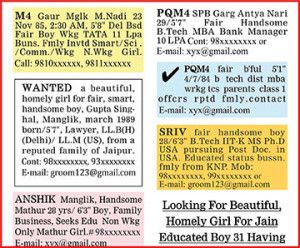
 Earlier, these elaborate affairs were managed by friends and relatives but these days when everyone’s lifestyle have changed and joint family structures have broken up into nuclear families, quite a few of these ceremonies are managed by event managers and catering agencies. We, at releaseMyAd have helped simplify Bengali marriage by providing the service of finding the future bride or groom. Apart from the traditional method of employing ‘ghotoks’ people trust newspaper advertisements to find their match. releaseMyAd has made matrimonial ad booking for Bengali community easy and hasslefree in the newspaper of their choice. The portal has been trusted for over a decade and has served more than 3 lakhs, happy customers. Through releaseMyAd you can book ads in popular Bengali newspapers like Anandabazar Patrika, Bartaman, Aajkal and also English dailies like Times of India and The Telegraph. We cover more than 100 newspapers all over India.

To place a Bengali matrimonial advertisement in any newspaper throughout India click on https://www.releasemyad.com/newspaper/cat/matrimonial/bengali and proceed on our self-serve platform. If you have any query and you are facing any difficulty in the booking process feel free to get in touch with our customer support team on Phone/ WhatsApp number 9830629298. You can also reach us via 24*7 Live Chat support or drop an email to book@releasemyad.com with all details.

Five Awesome Things You Can Learn From Times Of India Classified

You must be very familiar with the page name Times Interact! Yes, that’s the classified page of the Times Of India newspaper. It is the best classifieds newspaper page in the entire country with its 20 highly specific categories among which Matrimonial, Property, Recruitment, Business, Obituary and Announcement being the most advertised categories. The circulation of Times of India is wide and it ranks fourth largest daily in India in terms of circulation. Times Of India is owned by Bennett, Coleman and Co. Ltd., is one of the few newspapers in our country which have a huge loyal customer base. This is the only newspaper which is loved by everyone and hated by none. Times Of India is available in all parts of the country and makes the best source for advertising one’s product, brand or services.

One can easily advertise classified ads in Timclassiiedes of India to reach the target audience as it has a huge coverage. It has an extensive reach, low cost of advertising, high brand equity and much more. Being the leading newspaper globally it is the first choice of every advertiser. Let’s discuss some awesome points that you can learn from Times Of India Classified advertisements.

Times of India Classified
  1. Availability of selection of ad formats based on budget – There are two types of classified ad namely Text Classified ad and Display Classified ad under the classified section of Times Of India. Text advertisements are the simplest and economical form of newspaper classified advertising, usually printed in lines. The other form which is the Display Classified advertisements, includes richer formatting over and above the basic textual content of the ad, such as colours, a variety of typefaces as well as images or graphics. These ads are charged on the basis of square centimetres occupied and are little expensive than the text ads. Based on your budget you can select and one format to place your classified advertisements in Times Of India.
  2. Availability of selection of Enhancements and Formats – There are various enhancements available in Times Of India classified section such as ticks, screen borders, background colours, bold, underline which can be used to enhance your ads and attract more readers. These special enhancements are available for Text Advertisements in Times Of India. Classified Display advertisements enable usage of pictures/ logos as when required and allow customized font sizes which again enhances the ad quality. 
  3. Availability of selection of various categories and subcategories – Times Of India offers you the choice to select more than 20 categories namely Matrimonial, Property, Recruitment, Automobile, Business, Change Of Name, Lost & Found, Obituary, Remembrance, Education, Personal, Service, Astrology, Tender, Public Notice, Share Certificate Lost, Court Notice, Travel, Marriage Bureau, Computers and many more. There are a variety of sub categories available under each section which should be correctly selected to get relevant responses from the readers.
  4. Availability of selection of locations – Times Of India, being the most popular newspaper across the nation gives the leverage to place advertisements in more than 40 locations all over India. This is the only one newspaper which covers the whole of India and the best readership numbers. 
  5. Availability of selection of packages and offers – Times Of India offers multiple discounted packages based on every location. So based on your budget and requirement, you can choose your preferred package. From multiple locations together to multiple newspapers together, you can make your choice according to your need. There are also several insertion offers which Times Of India provides for each of the categories. 

ReleaseMyAd helps you in booking your ads in Times Of India while sitting at your home. The website provides facility for selection of advertisement type, category (matrimonial, real estate etc.), ad composition using sample ads, cities in which the ad will be displayed in newspaper and finally easy payment due to availability of both online as well offline payment options. Also, the team is experienced in this field for around 10 years. They provide consultancy to the client till he is satisfied with the result. 

For more details about Times of India classified ad booking, you can click on https://timesofindia.releasemyad.com/classified/Times-of-India-Newspaper-Ad or connect with us via Call/ WhatsApp at 9830629298. You may also drop an email to book@releasemyad.com.  We also provide expert support in providing assistance through live chat 24 x 7. 

History of Assam Tribune

Assam Tribune is the oldest English newspaper of Assam. It is the largest circulated English daily in North Eastern part of India with a circulation of over 700,000 copies and a readership of 3 million. It is currently published from Guwahati and Dibrugarh as a daily newspaper.

Originally Assam Tribune started as a weekly newspaper from Dibrugarh. It was launched on 4th of August, 1939 by Radha Govinda Baruah who was called the architect of modern Assam. He was an ingenious gentleman from Dibrugarh who conceived the idea of an English newspaper. Noted for his contributions towards Assamese society and culture, Radha Govinda Baruah, started the weekly with the initial help of some friends and well-wishers.

Radha Govinda Baruah appointed Lakshminath Phookan as the first editor of Assam Tribune. He formerly worked as an editorial staff of Hindustan Standard and later became one of the major figures of Assamese journalism. Under R.N Baruah and L.N Phookan, Assam Tribune soon became a popular newspaper which had wide circulation among tea estate managers, high schools and lawyers. At the time when Assam’s literacy rate was 10% among which not even 1% was English educated, publishing and increasing the readership of an English newspaper like Assam Tribune was a feat in itself. R.N Baruah was instrumental towards growing the educational needs of Assamese population.

Assam Tribune Advertising

R.N Baruah single-handedly managed the growth of Assam Tribune. He promoted the newspaper and collected advertisements from various establishments himself. In September 1946, Assam Tribune began publishing as a daily newspaper instead of weekly and shifted its publication to Guwahati. Eminent personalities of Assam contributed to the daily columns of Assam Tribune and thereby making it a popular daily among the masses. The newspaper covered news from all over North East but 2-3 pages were dedicated to news from Assam region. Established as well as fresh journalists represented the newspaper since the time of its inception.

Assam Tribune Classifieds

From its very beginning, Assam Tribune has dedicated itself towards truth without any sensational add on. It has been the principle of this newspaper to publish news in the correct perspective keeping in mind the welfare of the Assamese people. It always aimed at national advancement and became the voice of the people of even the lowest strata. It has been over 80 years since the publication of the first Assam Tribune newspaper and it still grows and represents the true spirit of Assamese journalism.

Today the managing director of Assam Tribune is Prafulla Govinda Baruah who is the son of R.N Baruah. He became the editor of the newspaper way back in 1966. For growth of literature and education in Assam, Prafulla Govinda Baruah was honoured with Padma Sri Award in 2018. Assam Tribune has truly contributed to the growth and development of the state of Assam.

Advertise in Assam Tribune

Advertisement is the chief source of revenue for a newspaper. During the days of its infancy, Assam Tribune struggled with advertisements. Unlike today, earlier Assam Tribune could not even fill two columns with ads. R.N Baruah, himself used to visit and collect advertisements from private and government organisations. However, with a readership of over 3 million today, it has become a lucrative platform to advertise for businesses and individuals. Publishing an ad in Assam Tribune guarantees the target audience with exceptional responses. 

To help simplify ad booking experience in Assam Tribune, releaseMyAd came into being in 2009. Leveraging the power of internet, releaseMyAd has enabled people to book ads for Assam Tribune from the comfort of their home or office with simple booking steps by clicking on the link https://assamtribune.releasemyad.com/

For designing ad creative, composing ad matter, budgeting and other booking related queries, the expert customer support team is available on the Phone/ WhatsApp number 9830629298. For details drop an email at book@releasemyad.com. Online chat support is also available on the website 24*7 for swift reply. 

Recruitment Advertising in The Times of India Newspaper: An Overview

All organisations, big or small, have hiring needs and publishing a recruitment ad in a newspaper is a time tested strategy to reach out to the candidates they want. In India, newspapers reach out to all nooks and corners of the country and it is a medium which is accessed by people of all generations. Publishing a recruitment ad in a newspaper ensures a generous number of candidates from which the best talent can be hired.

Ads in Times of India

When talking about newspapers, The Times of India is the best in terms of circulation and readership. The dominating readership figure of 1.5 crore and circulation of over 28 lakhs, The Times of India is the world’s largest selling English language daily. Publishing an appointment ad in The Times of India is bound to reach out to the desired audience. It is a trusted platform for big, medium and small establishments to publish recruitment/ appointment ad in The Times of India to fulfil their hiring requirements.

Times Interact Advertising

Recruitment ads in The Times of India can be published as classifieds or display as per the budget. Classified text ads are simple run-on line ads which are published in the classified section, Times Interact on any day of the week. Classified Display also publishes in the Times Interact page (classified section) but they are in a box with logo, colour, etc. which gives them better visibility compared to classified text. The height can be customized as per ad matter however; classified display ads have a specific width which corresponds to the column width of the newspaper. Display ads are premium ads with colour, logo, photo and designer fonts which can be created in any size and can be published on any page. However, certain pages like front, third and back page have extra page premium charges. Display ads can also be published on any day of the week.

Although appointment ads are published on any day of the week in The Times of India but Sunday and Wednesday is the recommended focus day. Especially, Wednesday is the awaited day as on that day Times Ascent pullout is published which is the appointment special weekly page and if an advertisement is published in the same, it is sure to hit the target audience.

Recruitment Display Ads i Times of India

Recruitment classified text ads can be composed in the bare minimum size of 5 lines. Extra line charges are additional. For example, if someone wishes to post a classified text recruitment ad in Times of India Bangalore edition the rate is Rs. 2350/ 5 Lines, extra lines charges are Rs. 588. Various special enhancements are available for classified text ads like colour background, tick, bold and screen which distinguishes the ad among the clutter. For Classified Display ads, the rates are calculated on the basis of sq.cm. The minimum size is 3 cm (width) X 5 cm (height). The height can be increased as per ad matter but the width is fixed. Thus, the minimum ad cost for a recruitment ad in The Times of India, Ahmedabad edition will be Rs.355 (rate) X 3 (height) X 5 (width) = Rs.5025. The rates vary as per editions and ad size across all ad types.

The minimum size of a display appointment ad for The Times of India is 4 cm X 4 cm and it can be customized as per needs and budget. Whereas the minimum ad cost can be as low as Rs.2500, a full-page appointment advertisement in any of the metro city editions can cost lakhs. The same goes for Times Ascent pullout in which only display appointment ads are published. The minimum size is 8 cm (width) x 6 cm (height) and cost varies based on edition, size and page preference. 

Placing an appointment ad in The Times of India is very easy, simple and hassle-free. With releaseMyAd, which is an online self serve platform, one has to just click on the link https://timesofindia.releasemyad.com/display-ad.php and proceed step by step after choosing the ad type that is Classified Text, Classified Display, Display or Times Ascent. releaseMyAd is an authorized online recruitment ad booking partner of The Times of India and the rates are transparent and best in the industry. Also, there are various offers and discounts available in the portal which can be availed to reap the best benefits out of a recruitment advertisement in The Times of India.

Negotiated rates are also available for high budget appointment ads and can be availed by getting in touch with the Customer Service Desk on the Phone/ WhatsApp number 9830629298 and 9356222541. The customer service team also helps in matter composing and ad creative designing with the help of in-house designers. For details, one can also email to book@releasemyad.com. 24*7 Live Chat option is also available for a quick response.   

History of Deccan Chronicle

Deccan Chronicle Holdings Limited (DCHL) is currently owned by the SREI group after ailing for two years. Deccan Chronicle was Andhra Pradesh’s largest English daily and with its unbiased journalism for the last 75 years, this newspaper has earned the respect of readers all over the country today.

Deccan Chronicle was the brainchild of Sarojini Naidu’s son, a homeopath, M.N. Jaisoorya, journalist Theodre La Touche and advocate, B. R Chari. This idea of “everybody’s newspaper” for Hyderabad was received by Rajagopal Mudaliar who was a supplier of paper to Nizam of Hyderabad’s press and hence, Deccan Chronicle was born in 1938.

Deccan Chronicle Newspaper Advertising

It was a newspaper full of patriotism in the period before independence but mounting debts could not be repaid and the ownership was sold to T. Chandrashekhar Reddy in 1977 and thus began the episode of Deccan Chronicle’s modernization. His son T. Venkattram Reddy was associated with the newspaper from his young age of 21 and became the editor-in-chief after his father’s death in 1993. He hired P.N.V Nair to expand Deccan Chronicle and increase the circulation and very soon the newspaper climbed above 100,000 circulation figures. Deccan Chronicle became the largest circulated English daily in Hyderabad.

The story of Deccan Chronicle took a turn when T.V Reddy bought a stake in Asian Age with the flamboyant Vijay Mallya. Thereafter, rapid expansion of the group began in other diverse unrelated sectors. In 2003, Nellore edition commenced and on March 28, 2005, Deccan Chronicle launched the Chennai edition and by 2006, the circulation grew to over 2, 95,000 copies in Chennai alone. In the year 2008, Bangalore edition was launched along with financial daily Financial Chronicle. Coimbatore and Kochi editions were launched in 2010 and 2011 respectively.

During this period, Deccan Chronicle became one of the major players in the print media industry. The production capacity of the plants were increased from 3, 15,000 copies per hour to 4, 35,000 copies per hour.  New colour printing facilities were set up in Kondapur in Hyderabad and the company began an alliance with various national and international print and entertainment industry giants to spread its wings.

With success came lavishness of Reddy’s lifestyle and soon credit was running into crores. By a short span of time Deccan Chronicle accumulated a debt of Rs. 4000 crores. In the financial year 2010-11 for the first time Deccan Chronicle reported decline in profit and sales since it was listed in 2004. Meanwhile in 2012, Deccan Chargers the IPL team owned by the company got involved in spot fixing scandal and the franchise was later bought by Sun Network’s Kalanithi Maran for Rs 85 crore, and renamed Sunrisers Hyderabad.

Ads on Deccan Chronicle Newspaper

By 2011, share prices were falling and the debt of the company came into public light. Reddys took several off-balance sheet loans by pledging their promoter shareholding in Deccan Chronicle Holdings. As there was an increase in claims from the lenders, in 2012, six company directors resigned from the board. In the year 2013, Deccan Chronicle Holding published its last annual report. It was total mismanagement with huge debts. February 8, 2015, T. Venkattram Reddy was arrested by CBI for defaulting on his loans taken using false documents & dozens of other charges including forgery, criminal breach of trust and misrepresentation. 

Deccan Chronicle Classified

As per Indian Readership Survey 2013, the readership of Deccan Chronicle has declined to 337,000.  In 20 years time Deccan Chronicle has seen it all. It was a small newspaper of regional reach and it grew up to be a newspaper of national reputation with very high circulation and readership but declined due to mismanagement by its promoters. However Deccan Chronicle still continues to be published. 

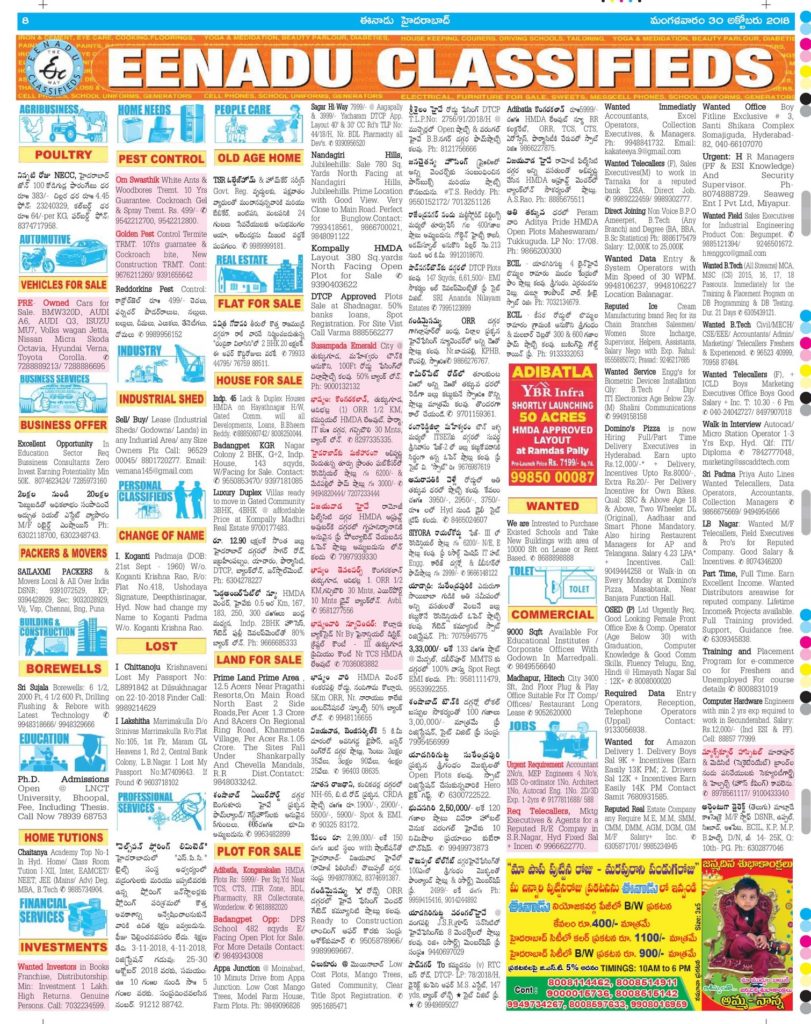
With comprehensive news and analysis, Deccan chronicle is still trusted and is a household name in Andhra Pradesh and Telangana. With presence in Hyderabad, Vijayawada, Rajahmundry, Vishakapatnam, Anantapur, Karimnagar, Nellore and Coimbatore districts Deccan Chronicle is a good platform to advertise in these regions. Advertising in Deccan Chronicle reaches out to specific English readership of the districts of Andhra Pradesh and Telangana.

To facilitate and simplify newspaper ad booking for Deccan Chronicle, releaseMyAd was incepted in 2009. This online self serve platform allows both classified as well as display booking for Deccan Chronicle across all categories. With a simple click of mouse from the link https://deccanchronicle.releasemyad.com/ ads can be booked for Deccan Chronicle.

For booking related queries, designing, composing and budgeting, the customer support desk is available on the Phone/ WhatsApp number 9830629298 or email address book@releasemyad.com. 24*7 Live Chat support can also be availed from the website for swift response.