
Rituals and Traditions of a Muslim Wedding in India

A Muslim wedding is known as a beautiful and soulful event which marks and celebrates a couple’s dedication to the faith. Muslim weddings are one of the most colourful and scintillating weddings that happens in our country. The wedding ceremony is divided into pre-wedding rituals, wedding rituals, and post-wedding rituals. They have been elaborated below : 

Pre-wedding Rituals:

  • Salatul Istikhara – This is the first ritual which is performed before the wedding. In Muslim communities, arrange marriages are more prevalent and the matches are within the same communities and religious sect. After the family members have finalized their match, the religious head (Imam) of the nearby mosque performs a special prayer where he asks God to bless the would-be couple.
  • Imam Zamin – Here the groom’s mother visits the bride’s home on an auspicious day. She carries gifts and sweets along with her. She also carries a gold or silver coin wrapped inside a silk scarf which is tied around the bride’s wrists. This ritual signifies the formal acceptance of the bride into her future family.
  • Mangni – Mangni is the official engagement ceremony between the bride and groom and their families. Families, relatives and close friends from both the families to witness the engagement where the couple exchange rings. Gifts like sweets, fruits, dry fruits, dresses are exchanged. 
  • Manjha – One to two days before the Nikah ceremony,  the bride is dressed up in yellow attire. A paste is made of Turmeric, sandalwood and rose-water and is applied to the bride’s face, hands and feet. All the women of the family gather for this occasion and participate in this fun loving event. Turn by turn the women apply the paste to the bride and to each other. After this, the bride goes on to take the bath. After this ritual, the bride is not allowed to leave the house till her wedding day. The same ritual also takes place in the groom’s house.
  • Mehendi – In this ritual, a henna paste is applied in the hands of the bride along with the other women present in the ceremony. This is a completely women-centric event, and the women of the family gather around the bride, the evening before the wedding. Ladies within the family sometimes apply the henna on the bride’s hands and feet or professional people are called for the mehendi application. It is customary to include the groom’s initials within the bride’s henna designs which he has to discern on their first night together. Other female members of the family also get their hands painted with henna.
  • Sanchaq – During this pre-wedding ritual, the groom’s family visit the bride’s place with gifts for her from her future in-laws. The gifts include sweets and the wedding attire and matching jewelleries to be worn by the bride during Nikah. 

Wedding day Rituals:

  • Baraat – The groom accompanied his close friends and relatives, set for the wedding venue. A car is sent by the bride’s family to pick up the groom. A member of the bride’s family goes to the groom’s place and escorts him on the way to the wedding venue. The relatives of the groom follow this car and the whole wedding party heading towards the wedding venue is known as the Baraat.
  • Welcome Ceremony – On the groom’s arrival, the groom and his family are warmly welcomed in a grand way by the bride’s family. They are then offered sweets and sherbet. The relatives of the groom also receive a grand welcome and are sprayed with attar-scented or rose-water as they enter the wedding venue.
  • Nikah – The Wedding in Muslim community is known as Nikah ceremony and is officiated by a religious priest called Maulvi. The men and the women are seated separately. The women generally take their place around the bride and the men with the groom. The bride’s father is appointed as the guardian to look after the bride’s interest in the Nikah by the Maulvi. The groom’s family gives Mehr to the bride which is generally a pre-decided amount of cash to seek her consent for marrying the groom. The Maulvi starts the Nikah proceeding by first saying a prayer from the Quran. Next, he asks the bride if she has consent in marrying the groom by accepting the Mehr. This is where he asks the bride the phrase ‘Qubool Hai?’ three times in a row. The bride has to reply by saying “Qubool Hain” three times. The Maulvi then moves on to the groom and repeats the procedure. This ritual is known as Ijab-e-Qubool. The bride and groom remain separated from each other so that they are not able to see each other. The Ijab-e-Qubool is followed by signing of the Nikahnama or marriage contract. The Nikahnama outlines all possible duties and rites of both the bride and the groom as decreed by the Quran. This is followed by the recital of Khutba, a religious discourse. The Maulvi then recites paragraphs from the Holy Quran which are equivalent to marriage vows. The bride and groom need not repeat these vows but listen to them. The elders of the family then shower their blessings on the newlywed couple.
  • Arsi Mushraf – In this ritual, the couple looks at each other for the first time after the marriage has been solemnized. A mirror is kept between the bride and the groom and the Holy Quran is placed on top of it. The couple looks in the mirror where they see the reflection of each other. 

Post-wedding Rituals:

  • Rukhsat – Once the wedding ceremony is over, the bride bids goodbye to her family and sets off for her new home. Once she arrives at her husband’s house, she is welcomed by her mother-in-law. The Holy Quran is placed on her head. 
  • Walimah – Walimah marks the public declaration of the marriage. A reception party is held where the bride and groom are generally seated on a throne atop a stage. They meet and greet all members from both families . The event includes a grand feast of traditional Muslim delicacies like Biryani, Meat Korma etc.
  • Chauthi – Thi is the last ceremony where the bride visits her parent’s home on the fourth day of the wedding and is accompanied by her husband. Her parents treat the newlywed couple with a grand lunch and give them various gifts. 

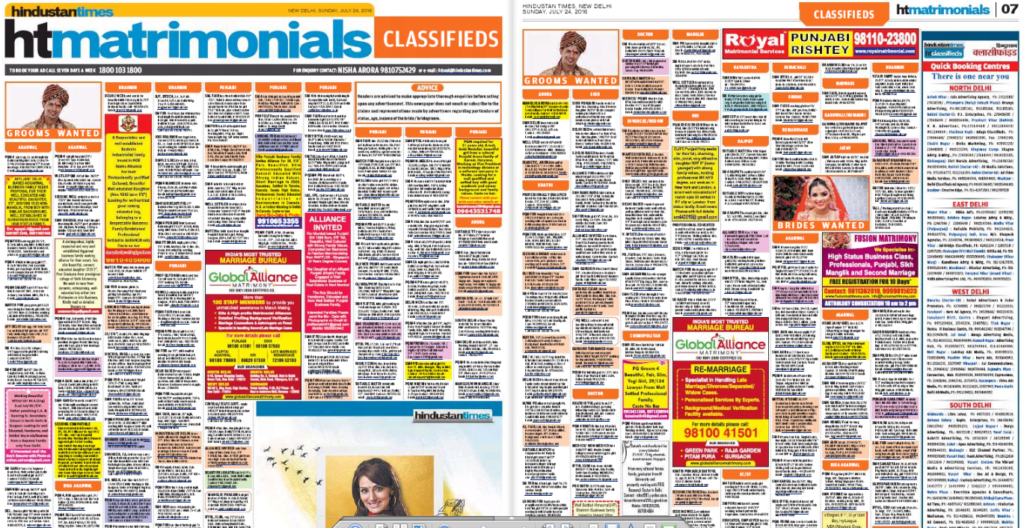
In Muslim families, the men and women are strongly encouraged to marry as soon as possible. They are not free to date or intermingle, which results in a more drawn-out and deliberate process. The amount of choice and acceptance involved in choosing marriage partners often depends on the class and educational status of the family. Newspapers play a very important role in finding suitable alliances. releaseMyAd is the best platform to place Muslim matrimonial ad in the newspaper. releaseMyAd is an online ad booking portal that is INS accredited, serving for more than 10 years in more than 270 newspapers.The advertisers are given the privilege to get the cheapest rates directly and place the ad in the newspaper in an easy and hassle free manner. You can choose any newspaper based on the number of circulation and the readership numbers. 

So, for placing urdu matrimonial advertisements in the newspaper, just click on the link https://www.releasemyad.com/newspaper/cat/matrimonial/urdu. You can also write to us at book@releasemyad.com if you have any query related to your matrimonial ad. We are available at 9830629298 via call or whatsapp  and 24 x 7 Live Chat support. 

Specialities of a Kannada Wedding

Every region of Karnataka has its own custom of wedding but the basic rituals of Kannada wedding is same all over. Usually all Indian weddings are characterised by pomp and show but Kannada weddings are known for their simplicity and adherence to old tradition. A Kannada wedding lasts a couple of days and consists of various ceremonies which have deep and has intricate meanings. Let us take a peek into how a Kannada wedding takes place.

The engagement ceremony in a Kannada wedding is called ‘Nischay Tamulam’. This is the ceremony when both the bride and the groom’s horoscope are matched and the wedding is fixed. The groom’s father gifts the bride new clothes, coconut and sweets and the same is gifted by the bride’s father to the groom. A priest then fixes an auspicious day for the wedding. ‘Naandi’ is a ceremony which is observed next in the household of both the bride and the groom. It is a puja performed by the family priest to ensure that the wedding is without any obstacles. A traditional kalash with a coconut is placed which symbolizes the beginning of the wedding ceremony. The first invitation card is given to the family deity so that the would-be couple is blessed. ‘Kaashi Yatre’ is a fun filled tradition observed in Kannada weddings. The groom pretends to be angry with everyone for not finding a suitable bride for him. He threatens his family to go for a pilgrimage to Kaashi and packs up rice, coconut, umbrella, walking stick and dhoti. At this point the groom’s maternal uncle stops him and places the chosen girl in front of him. The groom changes his mind and agrees to stay and get married to the girl. 

‘Dev Karya’ is a ritual observed by the groom on the day of the wedding. He visits all temples in the neighbourhood and seeks blessings from the deities. All articles that will be used in the wedding ceremony are placed in front of Lord Ganesha and his blessings are sought and the articles are sanctified.

Kannada Matrimony

The main wedding ceremony starts with the welcoming of the groom and his party at the venue. Five Sumangalis or married women perform aarti of the groom and then he is ushered inside the marriage hall. A puja is performed by the presiding priest where all the rituals of the wedding will take place. It is called ‘Mandap Puja’. This is done to sanctify the wedding mandap. The next ritual is the ’Var Puja’. The groom is considered as an incarnation of Lord Vishnu and he is worshipped by the bride’s family. The bride’s father washes his feet, performs puja and presents him with silk dhoti and scarf known as pitambar which the groom wears during the entire wedding ceremony.  

The bride is now brought to the mandap, her face covered with peacock feather fans held by her sisters. There is a cloth curtain between the bride and the groom to prevent them from seeing each other. The curtain is gradually removed as the priest chants the mantras and the bride and groom have the first glimpse of each other. After that the floral garland is exchanged three times which is called ‘Jaimala’. ‘Dhareherdu’ is the kanyadaan ceremony. The bride’s right hand is placed on the groom’s right hand and coconut and betel leaf is placed on top of that. The bride’s parents now bless the union by pouring holy water on top of the joined hands. The couple now goes around the sacred fire seven times with the nuptial knot tied. This ritual is called ‘Saptapadi’ and the bride follows the groom. Together they utter the sacred marriage vows.

The bride and the groom now sit down and the groom ties the mangalsutra around the bride’s neck assisted by five married women. With this ritual the wedding concludes and the couple seeks the blessings of the elders of both the families.

There are quite a few post wedding ceremonies in Kannada weddings. ‘Okhli’ is a post wedding game played to break the ice between the two families. The groom’s ring is dropped in a vessel containing milk and coloured water and the bride and her brother has to find the ring. Three rounds of the game is played and if the bride is successful in finding the ring then it is considered that she will be able to manage all challenges of her marital life.

The bride’s final and tearful goodbye from her parental home is called ‘Vidaai’. All things required for starting a new home like cot, utensils, cooking pots, umbrella, etc. are given to the bride and her brother accompanies her to her in-law’s house. He stays there for the night and returns the next morning. The welcoming ceremony of the bride at the groom’s house is known as ‘Griha Pravesh’. Her mother-in-law welcomes her with an aarti and the bride enters the house by turning over a vessel full of rice with her right feet symbolizing overflowing prosperity with her arrival.

There is a ritual of cloth presentation by the groom to the bride. She is presented with five sarees which she is to wear for various post wedding ceremonies. The ritual of name change ceremony is also a speciality of Kannada weddings. The groom chooses a new name for the bride and writes it with his ring on a plate of rice which is presented to the bride. The bride accepts the plate symbolizing her acceptance of the new name. On the second day of the marriage the bride’s parents visit the groom’s house to take the newlywed couple to stay at least one night at their house after which they return back to the groom’s house. 

In order to introduce the bride to the family, relatives and friends, the reception ceremony is arranged by the groom’s family. The bride is blessed by the elders and gifts are presented to her. With this the joyful and traditional Kannada wedding ends and the couple starts their blissful marital life.

If you are from the Kannada community living in Karnataka or anywhere around the globe and if you are looking to get married, newspaper matrimonial advertisement is the best and time tested method of finding the ideal bride or groom. For publishing Kannada matrimonial ads in newspapers, the portal of releaseMyAd is available for hassle free ad booking. releaseMyAd platform allows booking in wide number of popular Kannada and English newspapers from the state of Karnataka.

Publishing Kannada matrimony ads were never that easy and simple. Just follow the link https://www.releasemyad.com/newspaper/cat/matrimonial/kannada and start booking. If you still face any trouble booking the Kannada matrimonial ad do not hesitate to contact our customer support team on Phone/ WhatsApp number 9830629298. For more information you can drop an email to book@releasemyad.com. For instant support reach out our 24*7 Live Chat option on the website.

Know about The Traditions and Glamour of Marwari Wedding

Marwaris hail from Rajasthan and are one of the biggest business communities in India today. Marwari weddings are a community affair and apart from being full of traditions and rituals it is an expensive celebration which continues for many days. The elaborate display of wealth and customs make a Marwari wedding spectacular. It can be divided basically into pre-wedding rituals, wedding day and post-wedding rituals. Let us now check out how Marwari wedding customs and celebration goes ahead.

The event of ‘Sagai’ that is engagement takes place at the groom’s house. Elders from the bride’s side bless the groom and the bride’s brother applies kumkum and rice tika on the groom’s forehead. This ceremony is called ‘Mudha Tikka’. The family of the groom also visits the bride’s household with gifts of sarees and jewellery and the ring ceremony takes place. The ritual ends with seeking the blessing of elders and lunch.

‘Ganapati Sthapana’ and ‘Griha Shanti’ are two religious rituals observed in both groom and bride’s household after the ‘Sagai’ and it is performed by a priest to seek the blessings of Lord Ganesha and for appeasement of the planetary lords. Puja, havan and various other ceremonies are observed for successful completion of the marriage. 

The ceremony of ‘Sangeet’ is like an ice-breaking occasion with the bride. The future in-laws of the bride assemble around her, dressed in their fineries and share light jokes along with song and dance to popular Bollywood and folk songs. A separate occasion for the groom is a bachelor’s party where the groom along with his friends and male cousins get together to share jokes with dance and maybe some drinks. This is a time when the groom enjoys his last day of bachelor life.

The ceremonies of ‘Haldi’ and ‘Mehandi’ are another pre-wedding ritual of much importance and are celebrated in both the groom and bride’s household. ‘Haldi’ is the ceremony where the groom and the bride are bathed ritually after applying turmeric paste. ‘Mehandi’ is also a very joyous ceremony for the ladies of the house, especially the friends and cousins of the bride. Mehendi or henna dye is applied to the hands and feet of the bride and also the other ladies.   

The wedding attire of a Marwari bride and groom is very regal, traditional and elaborate. The groom is dressed in sherwanis, jodhpuris and turban with a sarpech. He carries a sword on his kamarbandh and wears traditional Rajasthani jootis. The bride dresses up in red Lehenga Choli and a heavy Odhni. She is decked up in traditional jewellery of gold, meenakari and kundan. 

On the day of the wedding, the groom heads out to the wedding venue but before that the ‘Sehra’ is tied around his head to hide his face. The ‘Sehra’ is usually made of flowers, zari or string of pearls. The procession leading to the wedding venue is called ‘Baraat’. The groom rides a horse and holds a sword which is typical of the Rajasthani Marwari tradition. The ‘Baraat Dhukav’ is the ceremony when the groom’s procession reaches the venue of the wedding. He is welcomed by the bride’s mother with ‘aarti’, sweets and water.

With the welcome of the groom, the main rituals of the wedding ceremony start.  The bride is brought into the wedding Mandap. She puts seven suhalis on the head of the groom. Suhali is a type of snack. Following this the bride and the groom exchange garlands which are known as ‘Jaimala’ or ‘Varmala’. At this point, the bride and groom’s odhni are now tied which signifies their union and is known as ‘Granthi Bandhan’. Later, the father of the bride performs the ‘Kanyadaan’ where he asks the groom to take the full responsibility of the bride and the bride also accepts the in-laws family as her own. In Marwari weddings, the bride and the groom go around the holy wedding fire seven times. For the first three rounds or ‘pheras’, the bride leads and in the next four, the groom leads. The next important ritual of a Marwari wedding is ‘Sindoor daan’. The groom puts vermillion on the forehead of the central hair parting of the bride symbolizing the marital status of the woman. After the final offering in the holy fire, the bride and the groom seeks the blessing of the priest and elders of the house and thus ends the wedding rituals. 

‘Joota Chupai’ is one of the entertaining parts of a Marwari wedding. The groom’s shoes are hidden by the friends and cousins of the bride and the groom has to bargain and settle for an amount to get his shoes returned. ‘Bidai’ is the process of the newlyweds leaving the parental house of the bride to the house of the groom. It is an episode of a tearful goodbye. Upon arrival at her husband’s home, the bride receives an elaborate and warm welcome from her mother-in-law who performs an ‘arti’ before ushering the bride in. The bride is asked to put her right foot over the threshold into a tray containing milk and vermillion solution. This ceremony is called ‘Griha Pravesh’. The bride kicks over a pot filled with rice and coins and enters the household of her husband. This symbolizes incoming of wealth and fertility. ‘Pagelagni’ and ‘Mooh Dikhai’ are the next rituals. The bride is introduced to the family and to its extended members and she offers her respects to them. Elder female member of the groom’s family lifts the bride’s veil and one-by-one and bless her. She is also presented token gifts on the occasion. ‘Chooda Pehenana’ is a ritual where the bride’s mother-in-law presents a set of lac and ivory bangles to the bride as a symbol of marital life and good omen. The entire wedding cycle is completed with the ‘phool sajja’ in which the bride and the groom sleep together and the wedding is consummated.

Marwari wedding is all about traditions and rituals and it is an occasion where the community is at their best. Right from the very beginning of the ceremony till the end it is like a celebration. We at releaseMyAd for last one decade have served the Marwari community to find an ideal matrimonial match with our newspaper advertising platform. With top newspapers in our listing and local Rajasthan circulated newspapers, releaseMyAd is a one-stop solution for finding the perfect bride or groom by placing Marwari matrimonial ads. 

releaseMyAd’s self-serve platform is user friendly and hassle-free and a matrimonial ad can be booked by simply clicking on the link https://www.releasemyad.com/newspaper/cat/matrimonial/hindi. Publishing a Marwari matrimonial ad in the newspaper was never that easy. The customer support can be reached out for any query or questions related to newspaper selection, composing and designing advertisement or choosing the best value matrimonial package. The customer support team can be reached out on the Phone/ WhatsApp number 9830629298. For details, email to book@releasemyad.com. For instant response 24*7 chat option is also available on our website.

Understand The Rituals and Traditions of a Malayalam Wedding!

Malayali weddings are filled with interesting traditions and rituals. The wedding ceremonies are very royal which involves uniting two individuals and their respective families in a sacred and lovable bond. In South India, people always try to provide the best education and all other facilities to their children. They even provide the best to their children even when it comes to finding the best match for marriage. Malayali parents take extra care to choose the life partners for their children. Even though Malayali families are quite broad-minded and accept love marriages, educational background and family background of the prospect is of prior importance.

Kerala is always believed to have the most amazing and breathtaking scenic beauty. This state also has some unique wedding customs too. Most North Indians wedding ceremonies are held after sundown. However, Malayali weddings often happen in the morning. Here are the pre-wedding rituals, wedding and post-wedding rituals that make the Kerala Hindu wedding a grand affair.

Pre-Wedding Rituals

  • Muhurtham – In this ritual, the astrologer matches the kundalis of the bride and groom. If the Kundlis matches, a Muhurath or a date for the wedding is fixed. 
  • Nischayam – Nischayam is the other name of engagement in Malayalam weddings. Both the families make an official announcement of the wedding in front of family, relatives and friends.
  • Traditional Party – The bride’s family organises a party for the guests just before the wedding ceremony and offers a delicious vegetarian meal for the guests.

Wedding Day Rituals

Malayali Wedding
  • Madhuparkam – When the groom reaches the wedding venue, he and his family members are welcomed in a grand way and the bride’s father washes the feet of the groom. The groom hands his in-laws a white saree which the bride is supposed to wear during the wedding ceremonies.
  • Kanyadaanam – All the wedding ceremonies are performed in front of a Veli (holy fire). The couple goes around the Veli three times and then the groom ties a Taali (yellow necklace) around the bride’s neck. After this, the actual Kanyadaanam ritual is done, where the bride’s father hands over his daughter’s hand in the hands of the groom. Kanyadaanam is the moment when the bride’s father gives his daughter’s hand in the groom’s hand.
  • Sparsham – During this ritual, the groom is made to sit on the floor where he faces the bride and their foreheads touch. The priest asks the bride to put rice in the Veli while chanting mantras. The groom helps the bride to put her foot on the Ammi (grinding stone) to signify that she is breaking ties with her family and stepping onto a new family.
  • Sadhya – After all the rituals have taken place, all the guests sit together and a feast is organized where traditional vegetarian dishes are served.

Post Wedding ceremonies

  • Kudivep – After the wedding is over, the couple starts for the groom’s house, where the newlyweds are heartily welcomed by the groom’s mother with lit oil lamps. This welcome ceremony is known as Kudivep.
  • Griha Pravesh – This is the ritual which takes place post wedding where the bride officially enters her new home for the first time.

When a person is looking for a suitable match, they are often confused with the options such us whether to create a matrimonial profile or seeking help from friends and relatives in finding a match within their known circle and this really becomes frustrating at times. This is where newspaper advertising comes in. Till now, there are a huge number of people around the world who depend only on the newspaper for searching suitable matches. This is because newspapers are the most reliable platform and the readers depend on them for any kind of information. Each newspaper earns credibility and is successful in establishing faith among the readers which is why the Indian parents mostly find brides and grooms from this platform. Malayali matrimony helps you to reach out to the elite and educated families whose value and ethics resemble yours. 

For finding the perfect Malayali matrimonial match, you can always advertise in leading Malayali newspapers which include the best selling Malayala Manorama, Mathrubhumi, Kerala Kaumudi, Deshabhimani, Metro Vaartha and Madhyamam. These newspapers have the highest readership and circulation figures which will surely assist you in reaching out to millions at one go. 

releaseMyAd was founded with the idea of booking advertisements online in national and local newspapers of India. With the aim to make advertising easy for the clients, the entire marketplace is brought at your fingertips enabling the advertisers in choosing from a wide range of options to fulfill their advertising goals. releaseMyAd simplifies your advertising experience by saving time and money. It eliminates the hectic process that one has to go through earlier. 
In order to place a Malayali matrimonial advertisement in the newspaper, just click on the link https://www.releasemyad.com/newspaper/cat/matrimonial/malayalam. In case you find any difficulty in booking the ad, feel free to call us at 09830629298 or write us at book@releasemyad.com. Our executives will get back to you within 24 hours. You will also get our 24 x 7 Live Chat support.

Bengali Weddings are not just lavish, but also culturally rich and diverse. Know more about it

Bengali wedding or what it is called in Bengali as ‘Biye’ is not just a day-long occurrence but a festival rich in tradition spanning multiple days. It is not just a union between two people but a ceremony where two families come together and become one. A ‘Biya’ is divided into basically three parts: Pre-wedding rituals, wedding rituals and post-wedding rituals. The entire episode is defined with the gathering of friends and family, good food, glamorous clothes and jewellery and religious rituals. Let’s explore how the entire event goes ahead.

 A traditional Bengali arranged marriage is facilitated by a matchmaker called ‘Ghotok’. They are usually friends or relatives and can be from any side. They introduce the families and on certain day parents of the bride or groom along with other relatives go to the other party’s house to formalize the marriage known as ‘Paka Kotha’. On an auspicious day after that elders from the groom and the bride’s side visit each other’s place and bless the boy and the girl with clothes and gold ornaments. This formal occasion is known as ‘Ashirwad’. Food being an integral part of Bengali culture, all aspects of a Bengali Biye is accompanied by elaborate lunch or dinner. ‘Aai Budo Bhaat’ is such a ceremony where the bride-to-be has her last meal in her parent’s household. Women of the household on both the sides play an integral part in a few sacred rituals prior to the main wedding ceremony. Some of these rituals are ‘Ananda Nadu’ which is associated with coconut, sweets and puffed rice, ‘Dhodhi Mangal’ early morning ritual on both the groom and bride’s family, ‘Holud kota’ grinding of turmeric for anointing the bride and groom. ‘Vriddhi’ is a solemn occasion where the ancestors are invoked and are usually performed by a paternal uncle.

Early morning of the day of the wedding is accompanied by quite a few traditional rituals on both the bride and groom’s side. One such important ceremony is ‘Gaye Holud’. Prior to that, ‘Adhibas Tattwa’ is received by the groom’s family from the bride’s side which includes fish, sweets, curd, paan, clothes, etc. During ‘Gaye Holud’ the groom is bathed after applying turmeric paste and the same turmeric is sent to the bride’s house along with ‘Gaye Holud Tattwa’ for the bride to take bath. This is followed by ‘Sankha porano’ ritual in the bride’s household where the bride wears the sankha and pola bangles symbolic of a married Bengali woman.

The main wedding rituals commence with ‘Bor Boron’ that is welcoming the ‘Bor’, the groom to the bride’s place. The groom is accompanied by a trail of ‘Bor Jatri’, members of the groom’s house as well as his friends headed by a guardian known as ‘Bor Korta’ and the groom’s best man ‘Nid Bor’ who is the youngest member of the groom’s family.  The groom is then seated in the ‘Chadnatola’ which is the wedding altar and is offered new clothes by the person from the bride’s side that performs ‘sampradan’.

Thereafter, is the ceremony of ‘Saat Paak’ where the bride is carried on a wooden seat called ‘piri’ by her brothers and circled around the groom seven times. The bride all this time hides her face behind beetle leaves which she holds in her hand. After ‘Saat Paak’ is ‘Subho Dristi’ when the bride removes the beetle leaves and the bride and groom glances at each other for the first time. The bride continues to sit on the ‘piri’ carried by her brothers and the ceremony of ‘Mala Bodol’ is carried out which is the exchange of flower garlands. This entire process is full of enjoyment and fun accompanied by the sound of conches and ‘ullu’.

The solemn Vedic ceremony of ‘Sampradan’ takes place after that where an elderly male member of the bride’s family hands her over to the groom. Followed by that is yagna and the ritual of ‘Saptapadi’ which is a bit different from ‘phere’ which happens in North Indian weddings. In the ‘Saptapadi’ ritual of Bengali marriage, the bride steps on seven laid out betel leaves and the groom follow her moving with his foot the stone called ‘nora’ which is used for grinding spices. Later, ‘anjali’ is offered to the fire using puffed rice by the bride and groom and the brother of the bride helps in the process. The last ritual of the wedding is ‘Sindor daan’ where the groom offers vermillion to the bride’s hair parting which is symbolic of Hindu married women. The entire evening is celebrated with guests, friends and relatives and a huge table and menu are spread out with delicious traditional and contemporary dishes to relish upon which quintessentially includes fish preparations and sweets like rosogolla. The bride and groom stay that night in ‘basor ghor’ kept awake by friends and relatives with jokes and merrymaking. Next morning happens the ritual of ‘bashi biye’ where in the priest’s presence, Sun god is worshipped.    

Bengali wedding is incomplete without the post-wedding ceremonies which happen in the groom’s household. Day after the wedding ceremony is the farewell ceremony called ‘biday’ which is a moment of sorrow and joy in the bride’s household. The new bride is welcomed to the groom’s house with the rituals of ‘bodhu boron’. The bride enters the house after being welcomed by the mother-in-law stepping on milk and alta. This night is known as ‘kalratri’ and the bride and groom are separated. On the third day after the wedding is the ceremony of ‘bou bhaat’. The bride cooks for the first time in the groom’s household and the groom formally takes the responsibilities of the bride’s basic needs known as ‘bhaat kapor’. This is followed by a reception of family, relatives and friends who are introduced to the bride and again a huge menu is laid out to the guests. The last tradition of the entire ceremony is ‘phool sajja’ where friends of the groom decorate the bed of the newly wedded couple and flower, clothes and sweets come from the bride’s house.

The ritual of ‘dira gaman’ is observed after a few days from the wedding. This marks the newly wedded couple visiting the bride’s house for the first time after the wedding ceremony. With this auspicious occasion, a Bengali wedding ceremony comes to an end and the bride and groom and their families are unified in a forever bond.

Bengali Matrimonial

 Earlier, these elaborate affairs were managed by friends and relatives but these days when everyone’s lifestyle have changed and joint family structures have broken up into nuclear families, quite a few of these ceremonies are managed by event managers and catering agencies. We, at releaseMyAd have helped simplify Bengali marriage by providing the service of finding the future bride or groom. Apart from the traditional method of employing ‘ghotoks’ people trust newspaper advertisements to find their match. releaseMyAd has made matrimonial ad booking for Bengali community easy and hasslefree in the newspaper of their choice. The portal has been trusted for over a decade and has served more than 3 lakhs, happy customers. Through releaseMyAd you can book ads in popular Bengali newspapers like Anandabazar Patrika, Bartaman, Aajkal and also English dailies like Times of India and The Telegraph. We cover more than 100 newspapers all over India.

To place a Bengali matrimonial advertisement in any newspaper throughout India click on https://www.releasemyad.com/newspaper/cat/matrimonial/bengali and proceed on our self-serve platform. If you have any query and you are facing any difficulty in the booking process feel free to get in touch with our customer support team on Phone/ WhatsApp number 9830629298. You can also reach us via 24*7 Live Chat support or drop an email to book@releasemyad.com with all details.