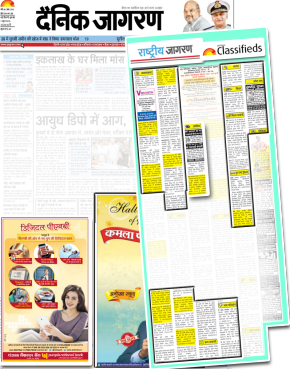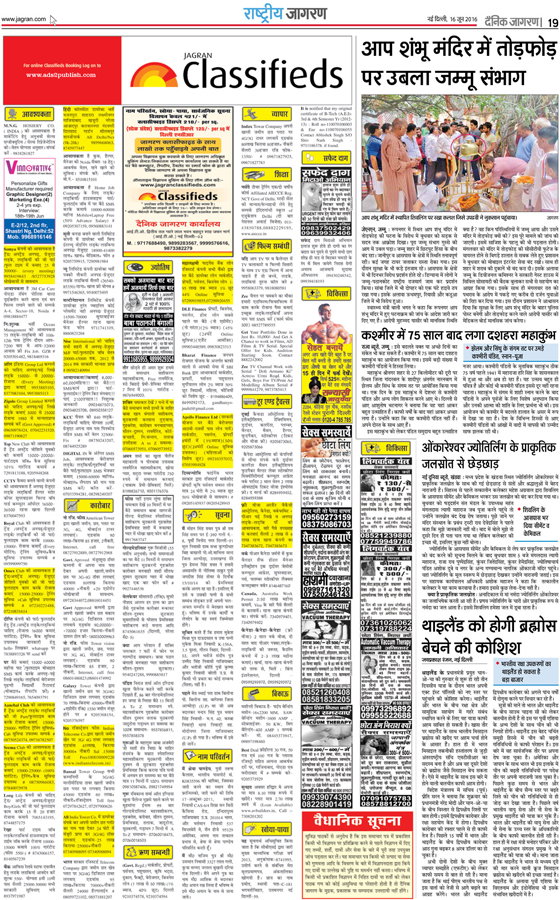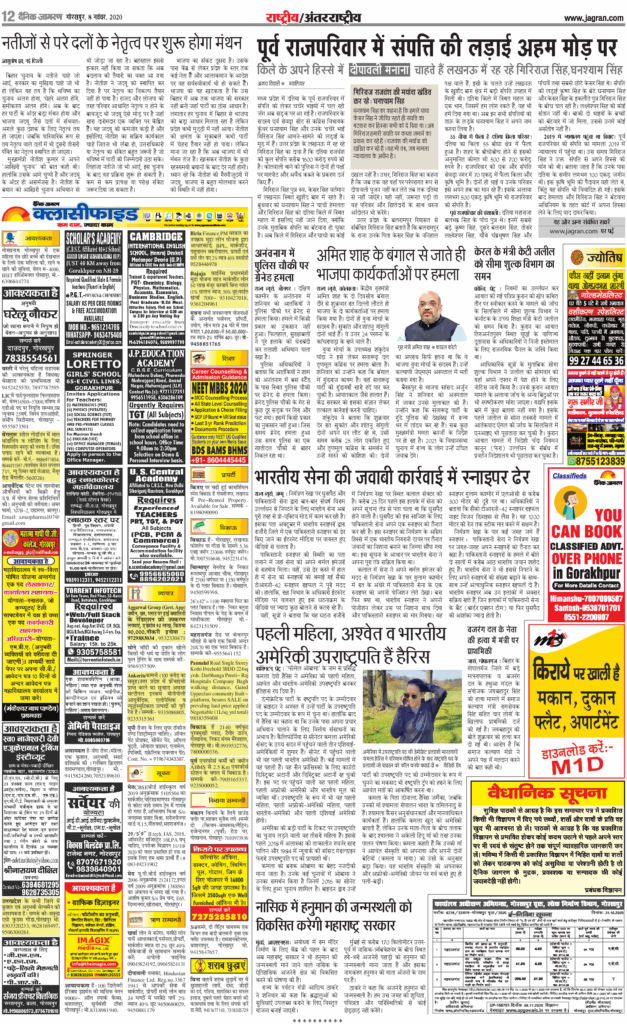

A Dainik Jagran classified ad reaches an audience that very few other Indian publications can match — the Hindi-speaking heartland of the country, spread across small towns, district headquarters, and metro cities. The newspaper is not just one of many Hindi dailies; in much of its core geography, it is the first paper that families pick up in the morning. That readership pattern is what gives a Dainik Jagran classified ad its reach.
This guide explains where Dainik Jagran is strongest, why its readership concentration matters for classified advertisers, and how to read the per-edition circulation data to plan an ad that lands in the right place.
What “Hindi Belt” Means for an Advertiser
The Hindi belt is not a single market. It is a stretch of states — Uttar Pradesh, Bihar, Jharkhand, Uttarakhand, Madhya Pradesh, Chhattisgarh, Rajasthan, Haryana, Himachal Pradesh, Delhi — where Hindi is the dominant first language but where reading habits, household sizes, and consumption patterns vary widely city by city. An advertiser planning a Hindi-belt campaign is not reaching one audience; they are reaching dozens of overlapping ones.
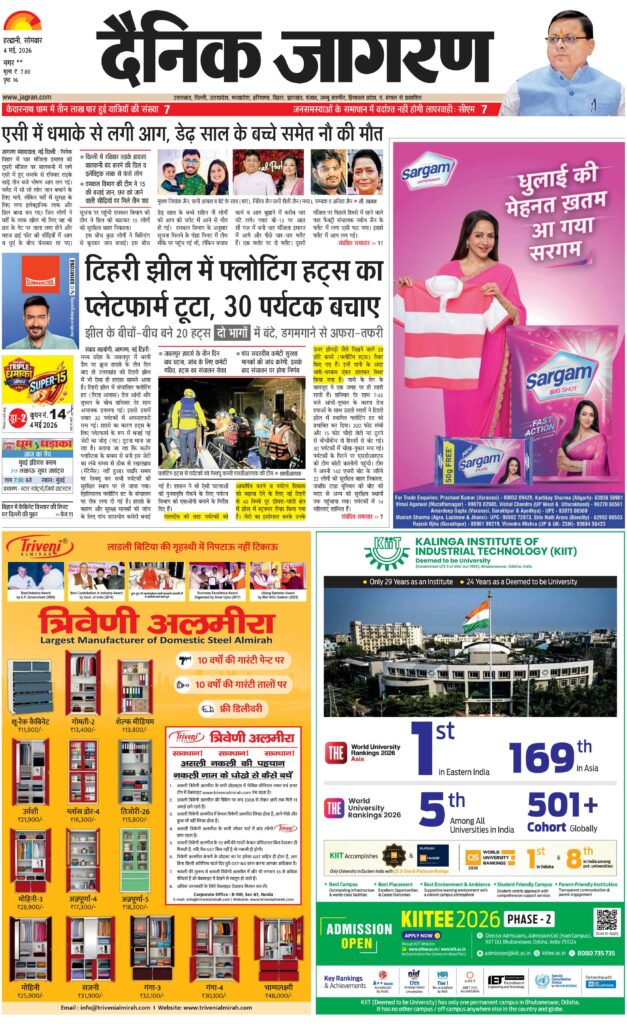
Dainik Jagran covers the eastern and northern parts of this belt particularly well. Its 26+ city editions are concentrated in UP, Bihar, Jharkhand, Uttarakhand, and adjacent regions of Punjab, Haryana, Delhi, and Himachal Pradesh. For a classified advertiser, this concentration is what makes the newspaper an efficient choice — the readers it reaches are the readers who matter for a Hindi-belt campaign.
Reading the Per-Edition Circulation Data
Circulation numbers are the cleanest way to compare editions. Higher circulation generally means more potential readers, but the more useful question is how circulation is distributed across cities — because that distribution decides where a classified ad will be most visible.
Tier 1 Editions: Above 3 Lakh Copies
- Delhi — 4,62,502 copies in circulation.
- Lucknow — 4,19,391 copies.
- Kanpur — 4,02,454 copies.
- Varanasi — 3,49,103 copies.
- Meerut — 3,01,804 copies.
These five editions together circulate close to 20 lakh copies daily. For broad-reach categories — recruitment for large workforces, matrimonial campaigns, big-ticket public notices — these are the editions that drive the bulk of the response.
Tier 2 Editions: 1 Lakh to 3 Lakh Copies
- Patna — 2,46,341 copies.
- Gorakhpur — 1,74,780 copies.
- Bhagalpur — 1,56,815 copies.
- Muzaffarpur — 1,54,321 copies.
- Agra — 1,50,190 copies.
- Allahabad — 1,38,044 copies.
- Bareilly — 1,22,729 copies.
- Dehradun — 1,18,763 copies.
Tier 2 editions cover the regional and district-level geography that Tier 1 alone misses. For property ads, school admissions, regional retail, and community-specific matrimonial searches, these editions are often more relevant than the metros — the readers are local, and the response is local too.
Tier 3 Editions: Below 1 Lakh Copies
- Moradabad — 96,201 copies.
- Jhansi — 82,425 copies.
- Hisar — 79,646 copies.
- Aligarh — 72,010 copies.
- Ludhiana — 67,285 copies.
- Nainital — 66,262 copies.
- Dhanbad — 65,138 copies.
- Jamshedpur — 55,997 copies.
- Panipat — 46,967 copies.
- Ranchi — 43,996 copies.
- Jalandhar — 42,045 copies.
- Siliguri — 21,536 copies.
- Jammu and Kashmir — 18,683 copies.
- Dharamshala — 11,474 copies.
Tier 3 editions cost the least and reach the most narrowly defined audiences. They are best used when the geography of the ad is specific — a notice about a property in Aligarh, a recruitment ad for a Panipat factory, a wanted-bride ad for a family in Nainital.
How Reach Translates to Response
A common assumption is that response volume scales linearly with circulation. It does not. A few practical effects shape how a Dainik Jagran classified ad actually performs:
- Pass-along readership — a single Dainik Jagran copy is often read by multiple family members, particularly in joint households across the Hindi belt. Effective readership tends to be considerably higher than circulation figures alone suggest.
- Section habits — readers in different cities use the classifieds section differently. Lucknow readers, for example, are known for using the Sunday matrimonial pullout heavily, while Patna readers may engage more with the recruitment and public-notice columns.
- Local context — an ad placed in a small-circulation edition often reaches a more focused audience than the same ad in a large-circulation metro edition, because the reader is more likely to find the ad locally relevant.
What this means in practice is that a classified advertiser is rarely better off chasing total circulation alone. The right edition for a particular ad is the one whose readers are most likely to act on it — and that depends on the ad’s purpose more than on the raw number of copies printed.
Matching Reach to Ad Purpose
Broad-Reach Ads
For matrimonial, recruitment, and large-scale public notices, layering Tier 1 editions with one or two Tier 2 editions usually delivers the best balance of reach and cost. The Tier 1 editions provide volume; the Tier 2 editions extend the geography into adjacent regions.
Geography-Specific Ads
For property notices, lost-document advertisements, change-of-name announcements, and regional recruitment, a single Tier 2 or Tier 3 edition often suffices. The cost is much lower, and the audience is more relevant than a Tier 1 metro insertion.
Legal Notices with Wide Stakeholder Geography
Legal notices with stakeholders across multiple cities benefit from a Tier 1 edition for general publication plus relevant Tier 2 or Tier 3 editions for the specific cities where stakeholders are likely to live.
Confirming Edition Rates and Circulation
The complete list of Dainik Jagran editions with current circulation figures and tariffs is available on the Dainik Jagran classified ad booking page on releaseMyAd. Circulation data is provided edition-wise, which makes it easier to plan a campaign around real reach rather than assumptions. Multi-edition discount packages are typically applied at the time of booking when more than one edition is selected together.
Frequently Asked Questions
Is Dainik Jagran the largest Hindi daily in India?
Dainik Jagran is one of the most widely read Hindi-language daily newspapers in India, with strong circulation across UP, Bihar, Jharkhand, Uttarakhand, and Delhi. It competes closely with other major Hindi dailies in different markets.
Does higher circulation always mean a better Dainik Jagran classified ad result?
Not necessarily. Higher circulation increases the number of potential readers, but the right edition for a classified ad is the one where readers are most likely to find the ad relevant. For geography-specific ads, a smaller edition in the right city often outperforms a larger edition in the wrong one.
How is circulation different from readership?
Circulation refers to the number of newspaper copies printed and distributed, while readership refers to the number of people who actually read those copies. In Hindi-belt households, a single copy is often read by multiple family members, so effective readership tends to be higher than circulation alone suggests.
Which Dainik Jagran editions cover Bihar and Jharkhand?
For Bihar, the main editions are Patna, Bhagalpur, and Muzaffarpur. For Jharkhand, the editions are Ranchi, Jamshedpur, and Dhanbad. A classified ad covering Bihar and Jharkhand is usually built by combining two or three of these editions.