

Which Newspaper Should You Choose for a Name Change Ad?

Book a daily newspaper that circulates where you live — and if this is for a passport, expect to need two: one English daily and one regional-language daily. That is the short answer, and the rest of this guide explains how to pick the right ones so the ad is right the first time.

A name change ad in newspaper is a public notice you publish before your new name becomes official on documents. It usually comes after a notarised affidavit — the affidavit comes first, and you arrange it with a notary yourself. Most offices accept the affidavit only if it is recent, often within six months. The ad then announces the change exactly as the affidavit states it.

The process is simpler than most first-timers expect. You pick the newspaper (or newspapers) your office asks for, write the notice using the details from your affidavit, book online, and the ad prints in the city edition you chose. There is no need to visit a newspaper office in person. releaseMyAd gives ready sample formats and publishes exactly what you approve — it does not provide, draft, notarise or translate the affidavit or the legal wording.

So, which newspaper for name change ad — the short answer?

If your office asked for one newspaper, book the daily that most people in your own district actually read. For many passport cases, the requirement is two newspapers: one in English and one in the regional language of the state you live in. The exact rule — one or two, and which languages — depends entirely on the office handling your file, so confirm it with them before you book. Choosing a well-known daily that circulates in your own district is the safest bet when your office gives you a free choice.

Which English newspaper should I pick for a name change ad?

Pick an English daily that circulates in your own city. The English newspapers that carry name change ads include:

  • The Times of India
  • Hindustan Times
  • The Hindu
  • The Telegraph
  • The Tribune
  • Deccan Chronicle

Any of these works when your office accepts an English daily — the deciding factor is circulation in your district, not prestige. If your office names a specific paper, follow that instruction exactly rather than substituting another.

Your best newspaper for name change ad is the one your office will recognise and your neighbours actually read. When in doubt between two, ask your office which it prefers.

Which regional-language newspaper should I pick?

The regional-language paper follows the same rule: a daily in the local language of your state that circulates in your own district. An English daily and a regional-language daily together is the pair many passport cases need. Options include:

  • Hindi: Dainik Bhaskar, Amar Ujala, Dainik Jagran, Punjab Kesari
  • Bengali: Anandabazar Patrika, Pratidin, Uttarbanga Sambad
  • Marathi: Lokmat, Sakal, Maharashtra Times
  • Telugu: Sakshi, Eenadu
  • Malayalam: Malayala Manorama, Mathrubhumi
  • Tamil: Daily Thanthi, Dinamalar
  • Gujarati: Gujarat Samachar, Sandesh
  • Kannada: Prajavani, Vijay Karnataka
  • Odia: Sambad, Dharitri

Choose the language your state office or passport office recognises. A Tamil resident booking a Marathi daily, or vice versa, defeats the purpose — the notice must be readable by the local community and the officials reviewing it. If your office has specified the language, treat that as fixed and only choose between the papers in that language.

Why does the city edition matter more than the newspaper’s name?

This is the detail that trips up most first-timers. A classified ad prints only in the city edition you book — not in every edition of the newspaper across India. Booking the “Delhi edition” may not reach Gurgaon or Greater Noida, so the edition must circulate in your own district. Your own address in the ad, your edition, and your office should all point to the same place.

Before paying, check the edition name on the booking page. If you live in Lucknow, book the Lucknow edition, not the Delhi one, even for the same newspaper. An ad printed in an edition that does not reach your district may not serve its purpose, and that is entirely avoidable.

Should I confirm the number and language of newspapers with my office before booking?

Yes — always. Passport offices, gazette offices, schools and banks each have their own rules, and the rules vary. One office wants a single English daily; another wants one English plus one regional-language daily; a third may accept only specific papers. Because the rule depends on the office, confirm these three things with them before you book:

  • How many newspapers: one or two?
  • Which languages: English only, or English plus a regional language?
  • Any named newspapers or named editions?

Getting this confirmed in writing (even an email or a printed instruction sheet) saves you the cost of re-booking. The affidavit wording and the ad details — old name, new name, father’s or husband’s name, address, affidavit date — must match exactly, so keep the affidavit beside you while booking.

How much does a name change ad cost?

Most name change ads cost Rs 300 to Rs 700 plus 5% GST. The price depends on three things: the newspaper you choose, the city edition, and the number of words in your ad.

Keep the wording short but complete. A standard format that offices recognise is:

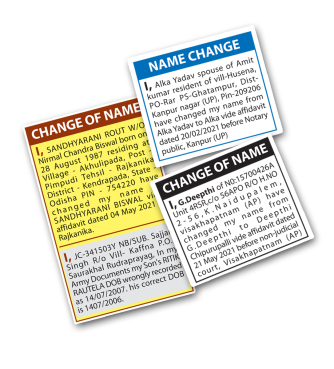
“I, [OLD NAME], S/o / D/o / W/o [father’s or husband’s name], residing at [full address], have changed my name to [NEW NAME] vide affidavit dated [date]. Both names refer to one and the same person.”

Extra words add cost, so do not add explanations, greetings or extra details beyond what your office requires. The price shown before payment is the price you pay — no hidden additions. After payment, the ad goes to the newspaper’s editorial team for approval and prints on the next available date, often the very next day when booked before the cut-off time.

Once it prints, save your proof: download the page from the newspaper’s e-paper with its date and edition visible, or buy a printed copy. The GST invoice for the booking is emailed to you.

Common questions

Can I book a name change ad online without visiting a newspaper office? Yes. The entire booking happens online — you choose the newspaper and edition, enter the ad text from your affidavit, and pay. The ad prints in the newspaper’s city edition on the next available date, subject to the newspaper’s editorial approval.

Do I need one newspaper or two for a passport name change ad? Many passport cases need two: one English daily and one regional-language daily. But the rule depends on the office, so confirm the number and languages with your passport office before booking.

Which newspaper for name change ad after marriage?
The same rule applies as for any name change ad: book the daily (or dailies) your office asks for, circulating in your district. If your bank or the gazette office wants a regional-language daily alongside English, book both. Confirm their exact requirement first.

What if my office rejects the ad?
Two things to check first are the edition (did the ad print in an edition that covers your district?) and the wording (does it match the affidavit exactly?). Rebook with the correct edition and the exact affidavit wording. We cannot promise that any office will accept an ad — acceptance is their decision.

How long after booking does the ad print?
After payment, the ad goes for the newspaper’s editorial approval and prints on the next available date — often the next day when booked before the cut-off.

Conclusion

Choosing which newspaper for name change ad comes down to three checks: the languages your office asks for, the dailies that genuinely circulate in your district, and the correct city edition at booking. Confirm the requirement with your office, keep the affidavit wording exact, and book the edition that covers your own address. To book, go to the name change ad page on releaseMyAd and complete the booking online.
Documents Required for a Name Change Ad in Newspaper: Affidavit and Steps

You need only two things before you can publish a newspaper ad for name change: a notarised name change affidavit, and a clear instruction from the office that asked for the ad. This guide to the documents required for name change ad in newspaper walks through both, step by step, so the notice is right the first time.

The affidavit always comes first. Most offices accept it only if it is recent — often within six months of your application — so get it made close to the time you apply rather than long in advance. Once the affidavit is ready, you can book your name change ad in newspaper online, and it will print in the city edition you choose.

Readers who ask “is affidavit required for name change ad” should know the answer is yes. The ad is not a standalone announcement; it is a public notice of a change you have already declared under oath. Everything below follows from that one fact.

What documents are required for a name change ad in newspaper?

Strictly speaking, the only document you prepare yourself is the notarised affidavit. It is a sworn statement, signed before a notary, in which you declare your old name and your new name. You arrange it with a notary yourself.

Why does it come first? Because the office that asked for the ad — passport, gazette, school, or bank — will see both the affidavit and the published notice, so the two must say the same thing. So the order matters: affidavit first, ad second. Book the newspaper advertisement for name change only after the affidavit is signed and sealed.

What must the affidavit state?

The affidavit must state these five things clearly:

  • your old name, exactly as it appears in your existing records
  • your new name, the one you want to use from now on
  • your father’s or husband’s name
  • your full residential address
  • the date on which it was sworn before the notary

Recency matters as much as content. Most offices accept an affidavit only if it is recent, often within six months of the date you apply. If yours is old, get a fresh one made before you book the ad.

How many newspapers does my office need?

This depends entirely on the office that asked for the ad, and you must ask them directly. There is no single national rule. Many passport cases need two newspapers: one English daily and one regional-language daily. Other offices accept a single notice.

Do not guess, and do not book before you know. One phone call or visit to the office saves you the cost and the delay of publishing twice. When you ask, also confirm which city edition they want. A classified ad prints only in the city edition that is booked — a “Delhi edition” may not reach Gurgaon or Greater Noida — so the edition must circulate in your own district.

What are the steps, in order?

  1. Get the affidavit notarised. Visit a notary with your old and new names, your father’s or husband’s name, and your address. You decide the wording; the notary witnesses and seals it.
  2. Ask the office what it needs. How many newspapers, which editions, and how recent the affidavit must be — get this in writing if you can.
  3. Publish the ad. Fill in the format exactly as the affidavit reads, then pay online. The price you see before payment is the price you pay: most name change ads cost Rs 300 to Rs 700 plus 5% GST, depending on the newspaper, the city edition, and the number of words.
  4. Wait for the printing date. After payment, the ad goes for the newspaper’s editorial approval and prints on the next available date — often the next day when you book before the cut-off.
  5. Save the published notice. Download the page from the newspaper’s e-paper, with its date and edition, or buy a printed copy.
  6. Submit it with your application. Attach the published notice, the affidavit, and the GST invoice, which is emailed to you after payment.

What does releaseMyAd do — and what does it not do?

releaseMyAd is the authorised online platform for booking newspaper ads in 280+ Indian newspapers. It gives you ready sample formats for a name change notice and publishes exactly the text you approve. After the newspaper’s editorial approval, the ad prints on the next available date.

What it does not do is equally important. It does not provide, draft, notarise, or translate the affidavit or the legal wording — the affidavit is yours to arrange with a notary. And it does not email or courier a copy of the newspaper to you; you save the e-paper page yourself.

What should I keep as proof for the office?

Keep three things together in one file:

  • the published notice itself — the e-paper page showing the date and edition, or a printed copy of the newspaper
  • the original notarised affidavit, which the ad must match
  • the GST invoice emailed to you after payment, as proof of booking

Common questions

Is an affidavit required for a name change ad?
Yes. The affidavit is the legal basis of the change; the ad only announces it publicly. Get the affidavit notarised first, then publish the ad with the same details.

Can I publish the ad without asking my office?
You can, but you risk publishing the wrong thing. Offices differ on how many newspapers they want, which editions, and how recent the affidavit must be. Ask first, publish once.

Does the ad text have to match the affidavit exactly?
Yes. The ad must carry the same details as the affidavit: old name, new name, father’s or husband’s name, address, and the affidavit date. A mismatch is the thing to avoid.

Which newspapers can I choose from?
releaseMyAd carries name change ads in English dailies such as The Times of India, Hindustan Times and The Hindu; Hindi dailies such as Dainik Bhaskar and Amar Ujala; and regional papers including Anandabazar Patrika, Lokmat, Eenadu, Malayala Manorama and Daily Thanthi, among many others. Pick the edition that circulates in your district.

How long does publishing take?
After you pay online, the ad goes for the newspaper’s editorial approval and prints on the next available date — often the next day if you book before the cut-off.

Get the affidavit right, confirm what your office wants, publish the ad with matching details, and keep the printed notice safe. That is the whole process — and when you are ready to publish, the change-of-name ad booking page on releaseMyAd is where you place the order.

When a New Name Needs a Proper Public Record

A name carries identity, history, family connection, personal choice and legal recognition. When someone decides to change their name after marriage, divorce, adoption, religious conversion, personal preference or the correction of a spelling error, the decision is not limited to everyday use alone. It must also be reflected across official records, financial documents, educational certificates and identity proofs. This is where a name change newspaper advertisement becomes important, as it helps announce the change publicly and creates a recognised record that supports future documentation.

Publishing a name change notice in a newspaper is often treated as an essential step in completing the formal process of updating one’s identity. Banks, passport offices, government departments, educational institutions and other authorities may ask for proof that the change has been publicly declared. A newspaper advertisement helps bridge the gap between the old name and the new one by clearly stating both, reducing confusion and strengthening the legitimacy of the change.

The process usually begins with preparing a name change affidavit that mentions the existing name, the new name and the reason for the change. Once the affidavit is notarised, the newspaper notice becomes the next important step. The advertisement is generally written in a specific format, with details such as the previous name, revised name, address or other required particulars. Accuracy is extremely important, because even a minor mistake in the notice can create delays when the person later updates official documents.

Choosing the right newspaper also matters. A publication with strong credibility and circulation gives the notice greater visibility and acceptance. Some people publish their notice in an English newspaper, while others also choose a regional-language newspaper depending on the requirement of the authority or the state where the change is being processed. This helps ensure that the announcement reaches the right audience and fulfils the expected public notice requirement.

Name Correction Ad

releaseMyAd makes this statutory requirement easier to complete by bringing the entire booking process online. Instead of visiting newspaper offices, speaking to several agents or trying to understand formats on your own, users can book their ad from home in a few simple steps. The platform allows individuals to select the newspaper and edition, use suitable ad formats, review the content and choose the publication date with ease. This helps save time while also reducing the chances of errors.

The platform is especially useful for people who are unsure about how to draft the notice correctly. releaseMyAd offers guidance, transparent pricing, secure payment options and access to a wide network of leading national and regional newspapers. Whether the requirement is a small spelling correction or a complete change of identity, booking a name change advertisement newspaper notice through releaseMyAd allows users to handle the process with greater confidence and convenience.

Take the next step towards making your new name official. Book your name change newspaper ad through releaseMyAd today and complete this important public notice requirement with ease, accuracy and peace of mind.

Claiming Your Identity: The Importance of Name Change Advertising

A person’s name carries profound meaning—it represents identity, heritage, and personal journey. It is more than a mere word; it is how the world recognises and addresses an individual. Yet there are times when life events necessitate a change in this vital marker of identity. Whether due to marriage, divorce, adoption, gender transition, or the need to rectify an error, publishing a name correction ad in newspaper becomes essential. This process ensures that the change is formally recorded and legally acknowledged, making it easier to align one’s new identity across official documents and institutions.

A name change advertisement is not simply a declaration—it serves as an official record that confirms the authenticity of the transition. Government departments, banks, educational boards, and passport authorities often require such proof to update their records. When a name change notice is published in widely circulated newspapers, it becomes part of the public domain, providing transparency and eliminating ambiguity regarding the individual’s identity. This procedural yet significant step ensures a seamless transition in both legal and personal spheres.

Before publishing the ad, individuals must prepare an affidavit detailing their old and new names, the reason for the change, and other identifiers such as residential address or parent’s or spouse’s name. Once notarised or attested by a magistrate, this affidavit serves as the legal basis for publishing the advertisement. Most regions in India mandate that the ad be published in both an English and a regional newspaper, thereby fulfilling the requirement of public notification. This dual publication ensures compliance while reaching a diverse audience for greater legal recognition.

While the process might appear complex, releaseMyAd has made it remarkably convenient. As India’s trusted ad booking portal, releaseMyAd simplifies the entire procedure of booking a name change ad. Applicants can select newspapers, choose publication dates, review sample formats, and make payments online without the need to visit multiple offices. The platform’s user-friendly interface, transparent pricing, and expert guidance make it a preferred choice for individuals across the country.

Through releaseMyAd, users can book ads in both local and national newspapers to meet specific legal requirements. Once the content is approved, the advertisement is published promptly, providing a hassle-free experience. The portal’s dedicated support team assists at every step, ensuring that the information is accurate and compliant with official standards. Whether the objective is a full name change or a minor correction, releaseMyAd’s efficiency ensures the process remains smooth and reliable.

For individuals addressing minor spelling discrepancies or typographical mistakes, publishing a name correction ad in the newspaper is equally crucial. Even small inconsistencies can lead to difficulties in documentation or verification processes. A published advertisement serves as verifiable proof, ensuring that all future references align correctly with the individual’s legal identity.

Through its streamlined process, releaseMyAd has brought transparency and ease to name change advertising, allowing individuals to reclaim or redefine their identity without unnecessary obstacles. The combination of professional support, affordability, and convenience transforms a mandatory procedure into a simple and empowering experience.

Take control of your identity today by booking your name change newspaper advertisement through releaseMyAd. With expert assistance, reliable service, and guaranteed lowest ad rates, you can complete this important step with confidence and ease. Begin the next chapter of your life knowing your name is officially recognised and celebrated—book your ad today.