
Traditions of a Tamil Wedding

Tamilians are always known for their elegance and simplicity even if it is something as big and extravagant as marriage. With all kinds of rituals and cultural norms that are much different from other Indian weddings, the Tamil wedding is one that gives importance to peaceful and spiritual union over pomp and grandeur. Tamilians give immense priority to their tradition and rituals which should be performed in the right manner. Weddings in the south are very different from those up in north India. Tamil people represent the major identity of South Indian communities and are known for their simple living and great education. Typical Tamil weddings are more about sticking to the age old customs and traditions than having lavish arrangements. 

Tamil weddings are always filled up with joy and happy moments. They have big events with distant relatives, friends and family members but they would make sure there will be no compromise on the actual traditional ceremony. Tamil weddings, also known as Kalyanam, take place during the day of all months of the Tamilian calendar except Aashad, Bhadrapad and Shunya. The Tamil wedding ceremonies are broken up in Pre Wedding, Wedding and Post Wedding rituals. Pre Wedding rituals consist of NakshatraPorutham, Marriage Agreement, Panda Kaal Muhurtham, Sumangali Prarthanai, Pallikal Thellichal, Vrutham, Naandi Shraddham, Nishchaya Tram and Lagna Pathirikai. On the day of the wedding, they have MangalaSnanam, Gauri Puja, Kashi Yathra, Pada Puja, Pada Puja, Oonjal, Kanyadanam, Muhurtham, Saptapadi and lastly the post wedding rituals are Reception, Sammandhi Maryathai, Paaladaanam, Grihapravesham, Valeyadal, Maruveedu Varudal.

Tamil Wedding

Pre-wedding Rituals:

  • Nakshatra Porutham – Matching of horoscopes are given utmost importance in a Tamil wedding. Horoscopes are matched which determines a lot of factors for the impending wedding like the wedding date, precise moment for the wedding or muhurtha and other rituals as well.
  • Marriage Agreement– The marriage agreement is created by the priests on both sides once the marriage date is fixed. A meeting is arranged at the groom’s place where both the families exchange the marriage agreements by putting it on a platter containing a bunch of bananas, betel leaves, betel nuts and a coconut. Gifts are then exchanged between the families.
  • Panda Kaal Muhurtham – During this ritual, both the families visit a temple or may organize a special puja at one of the homes, and pray to God so that the wedding may happen without any obstacles. This is generally done on the day before the wedding.
  • Sumangali Prarthanai – This is a puja directed towards the Sumangalis or married women who take part during the rituals of the wedding. These women are basically close relatives, family members and friends. The women, generally grouped in odd numbers like three or five or seven, get decked up in traditional sarees. Once the puja is completed, the bride seeks blessings from each Sumangali and gives her some special gift like a saree or jewellery. Lunch is also arranged for them.
  • Pallikal Thellichal – Clay pots are decorated with vermillion and sandalwood paste by five or seven married women of the family or both the bride and the groom’s families. Every pot contains nine different types of grains or navadhaanyam and are placed along with a bit of curd. A traditional south Indian sand art design that is believed to be bringing good luck, is prepared at a particular spot within the house.
  • Vrutham – This ritual takes place at the groom’s house in the early morning before the wedding day. The day signifies transition of the groom from the Bachelorhood phase to Domestic phase. He seeks permission from his father to proceed to this phase. A sacred thread which is yellow in color along with turmeric is tied around the groom’s wrists. In a similar ceremony or puja, a yellow thread is also tied around the bride’s wrists. This thread is said to protect the bride and the groom from evil energy.
  • Naandi Shraddham – During this ritual, the groom’s family arrives at the wedding venue on the morning of the day before. The bride’s family welcomes them with tray full of favors like sweets, betel leaves, betel nuts and fruits. The groom is especially welcome with a shower of rose water. A garland is put around the groom’s neck and a spot of sandalwood and vermillion paste is applied on his forehead. After the welcome, ten Brahmins are invited over who take part in a ritual that offers appeasement to the families’ departed ancestors. The Brahmins are treated to traditional Tamil vegetarian lunch and are given traditional two piece garments along with betel leaves, betel nuts, coconut, fruits and sweets. The Brahmins bless the couple and wish them a prosperous life ahead.
  • Nishchayathram – This is the engagement ceremony that is done formally. The ritual begins with a puja to lord Ganesh at the bride’s home. The groom’s family arrives at the bride’s house. They give a beautiful saree and jewelleries to the bride. They then apply a spot of sandalwood paste and vermillion on the bride’s forehead. The sumangalis from both sides come and fill up the free end of the bride’s saree with rice, fruits, coconut, flower, turmeric, betel nut and betel leaves. An arti of the bride is performed while a garland is tied around her waist. The bride’s family also performs a similar ritual and gives new clothes to the groom. The bride and the groom then change into these new clothes. In some families, the couple also exchanges rings after they have changed.
  • Lagna Pathirikai – This ritual involves announcement of the wedding and offering verbal invitation to the wedding. The family priests after consulting the couple’s horoscopes come up with the most auspicious moment of carrying out the wedding which they formally draft in the lagna patrikai which outlines the names of the family members, the bride and the groom’s, the marriage date and the marriage time. The time of the wedding or the Lagna is announced in front of all the family members of both the bride’s and the groom’s side. The lagna patrikai is seen and signed by the heads of the two families. Following this, gifts are exchanged between the two families.

Wedding Day Rituals:

  • MangalaSnanam – The Mangalasnanam ritual is observed separately by the bride and the groom’s sides. A paste of turmeric, sandalwood and kumkum is prepared by the married women. They take turns in applying oil to the bride/groom’s hair and applying the paste on their face, hands and feet. After the ritual, the bride/groom takes a bath in holy water to cleanse their body. They then proceed to get ready for the wedding ceremony.
  • Gauri Puja – This ritual is performed only by the bride. An idol of the Goddess Gauri, is placed on a plate containing rice and kumkum. After the bride has been dressed up, she offers her prayers and performs a short puja to the Gauri idol wishing for a happily married life ahead.
  • Kashi Yatra – The groom’s party arrives at the wedding venue and the groom grabs an umbrella, walking sticks and some food items to go off to Varanasi or Kashi, renouncing all worldly attachments to pursue religious studies. The father of the bride then intercepts him outside the wedding hall and makes him see the virtues of domestic life. The father of the bride then promises the groom to give his daughter to him in marriage. The groom accepts this proposal and returns to the wedding venue to get married. The umbrella is to be kept with the groom throughout the wedding to remind him of the decision and his duties thereby.
  • Pada Puja – After the groom arrives at the wedding mandap, the parents of the bride washes his feet with holy water, sandalwood, kumkum and milk. His feet are then wiped dry with flower petals.
  • Maalai Maatral – In this ritual, the bride is brought into the wedding mandap and the couple exchange flower garlands as a first step of the wedding. The ritual is repeated three times and the bride/groom tries to evade garlanding by the other.
  • Oonjal – Oonjal generally means a swing. During ritual, the couple is made to sit on the swing. The women of the family surround the swing and sing Oonjal Pattu songs. The elders of the family come one by one and feed the couple milk and banana and bless them. Women from both the families carry colored rice balls around the couple seated in the swing in both clockwise and anticlockwise directions three times before throwing the balls in four cardinal directions to remove evil energy. Older women also go around the couple holding an earthen lamp and pot filled with water three times in clockwise direction. The gentle rocking motion of the swing represents the turbulent situation that life may present to them.
  • Kanyadanam – The bride and groom is then asked to step off the swing. The end of the bride’s saree is tied to the end of the groom’s angavastram. The bride’s mother then applies kajal on the groom’s eyes and the bride’s father washes his feet. Through this ritual the groom is viewed as representative of Lord Vishnu. The groom is then made to sit on the floor at his designated spot. The bride’s father sits facing the groom. The bride is seated on her father’s lap and a coconut is placed on her hands. The bride’s father then supports his daughter’s hands and offers the coconut to the groom together. The mother of the bride pours holy water over the coconut. Through this ceremony, the bride’s parents give her to the groom and request him to take care of their daughter for the rest of their life. The bride and the groom’s hands are tied with a sacred thread to seal their union.
  • Muhurtham – After completion of the Kanyadanam, the groom’s parents present the bride with a nine yard silk saree symbolizing their acceptance of the bride into their family. The saree is draped around the bride’s shoulders while the groom applies vermillion to her hair parting. The bride then goes to change into the saree gifted to her by her in-laws. When she returns to the mandapam, a grass ring is placed on her head, over which the yoke of a plough is placed and a belt made of reed grass is placed around her waist. Water is poured over the yoke. This ritual is a symbolic reminder of the fact that the bride and the groom together have to overcome the challenges of life. The Thaali is blessed by the priest and the groom ties the Thaali, or south Indian equivalent of a mangalsutra, around the bride’s neck. The first two knots of the Thaali are put in by the groom while the third and the final one is put in by the groom’s sister.
  • Saptapadi – In this ritual, the bride and the groom hold each other’s hands and go around the sacred fire seven times. Mantras are chanted by the priest which depicts the seven sacred vows of a marriage. This ritual marks the symbolic beginning of the couple’s journey as husband and wife. The groom then holds the bride’s left toe as she steps over a grindstone. This symbolically represents the solidity of their union.

Post-wedding Rituals:

  • Reception –Once the wedding is over, it is followed by a formal reception in the evening where the guests are treated with a lavish vegetarian dinner. The newly weds are seated on a throne like chairs on top of a stage where they can meet the guests.
  • Sammandhi Maryathai – During this ceremony, The two families exchange gifts and the bride prepares to leave her paternal home. She is bid an emotional goodbye by her parents and relatives after they have prayed to God.
  • Paaladaanam – Before their departure, the bride and the groom lie face down and seek the blessings of the elders. The groom then escorts the bride to his home.
  • Grihapravesham– Once the bride reaches the groom’s home, she is given a warm welcome. The mother-in-law performs arti and escorts her inside the house where she is led to seek the blessings of the family deity first.
  • Valeyadal – This ritual refers to the formal introduction of the bride to the members of the groom’s family who offers her gifts. Several games are played to break the ice between the bride and the groom.
  • Maruvidu Varudal – Three days after the wedding, the couple visits the bride’s paternal home. They are welcomed and are fed a delicious lunch. The bride’s parents give the couple gifts. This ritual marks the end of all the wedding celebrations.

For a note, the most important aspect of any wedding is the wedding ensemble of both the bride and the groom but more stress is laid on the bride’s attire. It is selected much in advance and the accessories to go with it are also decided way before the wedding. A Tamilian bride looks every bit of a Goddess on earth in a beautiful kanjeevaram silk sari, wearing traditional gold jewellery from head to toe and showing off her long braid accessorized with hair jewellery and flowers. The groom, on the other hand, wears a dhoti and kurta or a sherwani if he wants. Ensure that the wedding outfits for both are decided and kept ready with all the accessories much in advance.

Traditionally, the whole of this wedding arrangements starting from choosing a bride or a groom were arranged by the family members. But in recent times, most of the families rely on advertising marriage ads in newspapers and online wedding portals to get the best match for the prospective bride or the groom. releaseMyAd, being an authentic online newspaper ad booking agency assists people to place their advertisements in any renowned newspaper of their choice. releaseMyAd has served more than 3 lakhs of customers and have more than 10 years of experience in the advertisement industry. You can advertise in more than 270 newspapers across the nation. 

To book Tamil matrimonial advertisement in the newspaper, you just need to click on the link https://www.releasemyad.com/newspaper/cat/matrimonial/tamil. You can also email us at book@releasemyad.com if you have any query related to your matrimonial ad. You can connect with us at 9830629298 via call or WhatsApp or take the help of the Live Chat support which is available for 24 x 7. 

Five Awesome Things You Can Learn From Times Of India Classified

You must be very familiar with the page name Times Interact! Yes, that’s the classified page of the Times Of India newspaper. It is the best classifieds newspaper page in the entire country with its 20 highly specific categories among which Matrimonial, Property, Recruitment, Business, Obituary and Announcement being the most advertised categories. The circulation of Times of India is wide and it ranks fourth largest daily in India in terms of circulation. Times Of India is owned by Bennett, Coleman and Co. Ltd., is one of the few newspapers in our country which have a huge loyal customer base. This is the only newspaper which is loved by everyone and hated by none. Times Of India is available in all parts of the country and makes the best source for advertising one’s product, brand or services.

One can easily advertise classified ads in Timclassiiedes of India to reach the target audience as it has a huge coverage. It has an extensive reach, low cost of advertising, high brand equity and much more. Being the leading newspaper globally it is the first choice of every advertiser. Let’s discuss some awesome points that you can learn from Times Of India Classified advertisements.

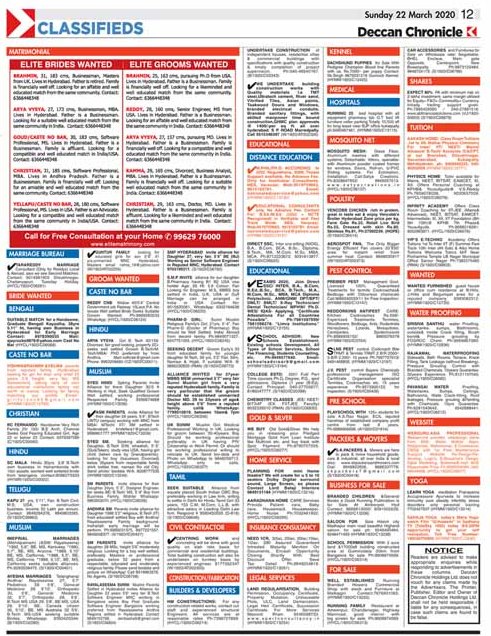
Times of India Classified
  1. Availability of selection of ad formats based on budget – There are two types of classified ad namely Text Classified ad and Display Classified ad under the classified section of Times Of India. Text advertisements are the simplest and economical form of newspaper classified advertising, usually printed in lines. The other form which is the Display Classified advertisements, includes richer formatting over and above the basic textual content of the ad, such as colours, a variety of typefaces as well as images or graphics. These ads are charged on the basis of square centimetres occupied and are little expensive than the text ads. Based on your budget you can select and one format to place your classified advertisements in Times Of India.
  2. Availability of selection of Enhancements and Formats – There are various enhancements available in Times Of India classified section such as ticks, screen borders, background colours, bold, underline which can be used to enhance your ads and attract more readers. These special enhancements are available for Text Advertisements in Times Of India. Classified Display advertisements enable usage of pictures/ logos as when required and allow customized font sizes which again enhances the ad quality. 
  3. Availability of selection of various categories and subcategories – Times Of India offers you the choice to select more than 20 categories namely Matrimonial, Property, Recruitment, Automobile, Business, Change Of Name, Lost & Found, Obituary, Remembrance, Education, Personal, Service, Astrology, Tender, Public Notice, Share Certificate Lost, Court Notice, Travel, Marriage Bureau, Computers and many more. There are a variety of sub categories available under each section which should be correctly selected to get relevant responses from the readers.
  4. Availability of selection of locations – Times Of India, being the most popular newspaper across the nation gives the leverage to place advertisements in more than 40 locations all over India. This is the only one newspaper which covers the whole of India and the best readership numbers. 
  5. Availability of selection of packages and offers – Times Of India offers multiple discounted packages based on every location. So based on your budget and requirement, you can choose your preferred package. From multiple locations together to multiple newspapers together, you can make your choice according to your need. There are also several insertion offers which Times Of India provides for each of the categories. 

ReleaseMyAd helps you in booking your ads in Times Of India while sitting at your home. The website provides facility for selection of advertisement type, category (matrimonial, real estate etc.), ad composition using sample ads, cities in which the ad will be displayed in newspaper and finally easy payment due to availability of both online as well offline payment options. Also, the team is experienced in this field for around 10 years. They provide consultancy to the client till he is satisfied with the result. 

For more details about Times of India classified ad booking, you can click on https://timesofindia.releasemyad.com/classified/Times-of-India-Newspaper-Ad or connect with us via Call/ WhatsApp at 9830629298. You may also drop an email to book@releasemyad.com.  We also provide expert support in providing assistance through live chat 24 x 7. 

Five Questions about Times of India Matrimonial that may come to your mind while placing an advertisement

All across India, if there is one newspaper which is trusted by parents for finding their son or daughter’s perfect match, it is Times of India. For generations Times Matrimonial classified section has served the need of finding the life partner of girls and boys eager to settle down and have a family. Today with over 3 million copies of the newspaper in circulation and a readership figure of over 7.6 million, Times matrimonial section is the best place to advertise across different states for finding a suitable bride and groom.

Wanted Bride & Groom Ads in Times of India

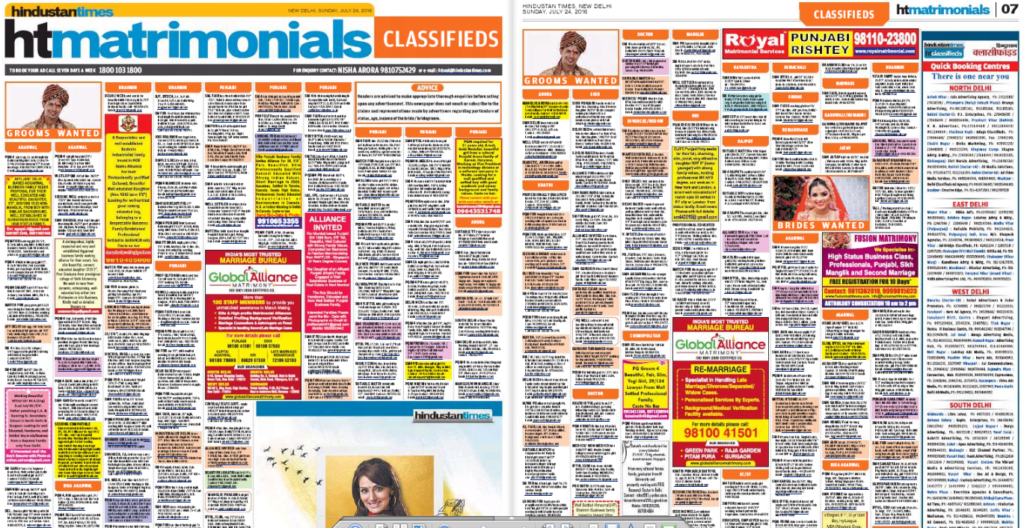
Every Sunday, hundreds of matrimonial ads are published in Times matrimonial section under various sub-categories of Brides and Grooms. Therefore, there are few basic things that should be kept in mind so that the readers are attracted towards your ad and favourable response is generated. While composing a matrimonial ad, there are certain questions that arise in the mind. If the advertiser goes ahead and addresses these, then there is all certainty that the attention of the readers is gained and the number of genuine response is high.

  • What are the things about the bride or groom that you should let the readers know?

There are few details about the bride and groom that must be included in a matrimonial ad. The first is age and educational qualification. The highest qualification should be included in the ad matter.  The family background should be added next and along with that detail of the profession. Food habits and physical characteristics can also be included for better response.

times Of India matrimonial Ad
  • Are astrological details of the bride or groom required in the ad text?

While it is not mandatory to add astrological and horoscope details if you do not have faith in the stars but if you actually care about the impact of stars and planets upon the future of the bride or groom, then you should add the same. It will also help you narrow down on those readers who share your belief and are eager for horoscope matching.

  • How important is placing a matrimonial ad under proper sub-category?

It is of utmost important to publish a matrimonial ad under a proper sub-category. Times of India Matrimonial section offers the option of selecting sub-categories based on caste or religion. If you wish to advertise otherwise there is the option of placing the matrimonial ad under sub-categories like By language, By profession, By community, Cosmopolitan, Caste No Bar, Religion No Bar, etc. Choose the most appropriate sub-category so that the readers can filter down to your ad based on what type of bride or groom they are looking for.

  • Is it also required to mention what type of bride or groom I am looking for?

The kind of bride or groom you are looking for should be mandatorily included in the ad text. You can mention whether you are looking for a bride with a particular qualification or a groom serving a certain profession and so on. This will help you receive genuine responses rather than unwanted enquiries.

  • Which is the best matrimonial package I should go with?

There are multiple matrimonial packages available in Times of India and sometimes it can be a bit confusing which one should be chosen. Focus on the package which has the location from where you want the prospective bride or groom. You can opt for a package which has the edition that covers that location. Then you can broadly decide on other nearby locations and chose the package that has those editions which cover nearby locations. If you are open with getting a bride or a groom from anywhere in India, you can go ahead with All Editions package.

To assist you with proper ad text composing and selecting the correct tailor-made package suitable for your need, releaseMyAd is here to help you. Through releaseMyAd you can book Times of India matrimonial ad online without any hassle. Having decades of experience in the advertising industry and being the online partner of Times of India ad booking, releaseMyAd is known for its reliability and trustworthiness. Click on the link https://timesofindia.releasemyad.com/rates/matrimonial and you can yourself go ahead with booking a matrimonial ad in Times of India through our self-support platform. You can also reach out for any assistance to the experienced customer support team over Phone/ WhatsApp number 9830629298. For detailed enquiry, you may drop an email to book@releasemyad.com or you may also connect 24*7 Live Chat support on releasemyad website for instant reply.

10 secrets you would like to know about Times of India Classified

Times of India is one of the best-known newspapers in India and it has been reporting daily news since the last 180 years. People have built trust around this newspaper and therefore it reaches out to many millions throughout the country. Times of India classifieds which is known as Times Interact is one of the powerful platforms for any individual or businesses to get hold of this immense readership base of Times of India to fulfil their advertising and promotional needs.

However, reaching out to the mass audience doesn’t actually mean achieving advertising goals. Proper targeting and getting in touch with the right audience will ensure the same. Let’s check out a few secrets which will make sure that the advertisement is done in the correct sense.

1.       That because you have a huge Times Interact page, there is all possibility that your ad might get lost among other ads. Special Enhancements options provided by Times of India are best for amplifying your ad among the clutter. Colour enhancement, Tick, screen and run-on-display are the few enhancements that can make a classified ad in Times Interact page impactful.

2.       Choosing the correct release date matters the most. Whereas all categories of ads publish all days of the week, except Matrimonial which publishes only on Sundays, there are few categories which have a special focus day. Best day to publish a recruitment ad is Wednesday and for Education, it’s Monday. Property ads publish in the Times Property section of Times Interact on Saturdays. An ad published on a focussed day generates extra responses.

3.       Always opt for the correct category and sub-category. No reader goes through the entire Times Classified page. They only check out the column which they require. Therefore, it is most essential to select the appropriate category and sub-category to receive relevant responses.

4.       Ensure to verify the newspaper edition which reaches the location where you want to focus your advertisement otherwise the entire campaign will be in vain. There are various small city locations which are covered by larger editions. An advertisement published in the wrong edition will generate no response whatsoever.

5.       Classified ad booking packages of Times of India are tailor-made for advertisers who want to advertise in multiple locations. These packages are pocket-friendly options and booking in one of these packages rather than a single edition ensures reaching out to a wider audience.

Times of India Classifieds

6. Many of the packages also include sister publications of Times of India like Maharashtra Times, Vijay Karnataka, Ei Samay, etc. Carefully choosing such a package will allow an advertiser to reach out to the audience speaking the local language of the state.

7.       Go ahead with multiple insertions offers if you are thinking of publishing your ad for more than one day. Offers like 2+2 and 3+3 are available to publish classified advertisements in Times of India. These offers not only saves money but multiple day ad releases multiply the responses of the ad.

8.       The ad text you are publishing should be crisp and short. The message that you wish to deliver needs to be summed up with basic points. A large ad matter for classified ads not only costs extra but also disinterests the readers.  Never forget to add the contact details in the ad text. It is better to add email id and a contact number.

9.     Ensure to mention the USP in the advertisement so that the readers are attracted to the special something in your product, service, property to be sold or rented or for instance special qualities of the prospective bride or groom in case of a matrimonial ad. For recruitment advertisements, the USP can be the special facilities of the job in the offer and it can be the amenities and advantages of the institute in case of an Education ad.

10. Times Interact page not only publishes Classified Text ads but also Classified Display ads which are in a box of minimum 3 cm width and 5 cm height. Whereas the height can be increased as per the ad text, the width remains constant as per the column width of the newspaper. If you are opting for such an advertisement make sure to use colourful fonts and background. An image or your brand’s logo gives added advantage. Dull coloured Classified Display ads can lose its purpose and there are all chances that the readers might overlook it.

We, at releaseMyAd have developed such an online platform where all the above details are available and the customers can easily navigate themselves through the website and select the options which will benefit their advertisement campaign. This self-serve platform has served more than 3 lakhs customers since its inception a decade ago. We are an authorized classified ad booking partner of Times of India.

For more details about the classified advertising in Times of India, visit https://timesofindia.releasemyad.com/classified/Times-of-India-Newspaper-Ad You can reach out to the expert team of customer support with your questions and queries at phone/ WhatsApp number 9830629298 or drop an email with your requirement to book@releasemyad.com. For urgent support 24*7 Live Chat option is also available on the website.

How can you place a Public Notice ad in Dainik Bhaskar Newspaper!

If we go back to history  it can be seen that the concept of notice is older than the existence of newspapers. Earlier, the cases were notified on public squares regarding any important legal proceedings, in order to make the public aware and to give notices to interested parties, in specific.  Later, with the advent of the newspapers, the orders coming from the King’s Court were published and circulated amongst the public. But with evolution the common method now is the print in newspapers.

Public notice are a an important part of the legal process to notify citizens about any ongoing or completed legal proceedings and is often considered to be of high value.  This is commonly done by  placing advertisements in newspapers and  is used as a medium to make people aware of any legal proceedings that have already taken place or are going to take place in the future.

Public notice is actually a formal announcement which is published in a newspaper legally by common individuals, companies or government as well.

Importance to publish public notice in Dainik bhaskar:

  • Notices are important to create public awareness of government activities, court hearings, public bids therefore to reach maximum people Dainik Bhaskar is a very good option as it covers the entire central northern parts of india.
  • Placing Dainik Bhaskar public notice ads is a most effective method of reaching a wide group of public because of its high circulation figure and is a pocket friendly option.
  • By printing public notices ads in dainik bhaskar newspapers end up serving both the public and the government. Public notices have a great responsibility as they inform the public of actions either big or small..
  • It accepts any public notice ad in the minimum size of 4cm X 4cm and the booking deadline is just one day prior. 

Documents required: There are various types of public notices ads and the documents depend upon what type of public notice you want to publish.

  1. Share Certificate Loss Notice: If the original share certificate gets lost, these ads are published to inform the general public & to file an application for issuing a duplicate share certificate.
    • Documents Required: Copy of FIR or General Diary Entry. Should not be more than 6 months old.
  2. Property Notice:  While making a property deal or to inform about a disputed property or change of ownership of a property these notices are published which make the process more transparent.
    • Documents Required: Ad matter in Advocates letterhead duly stamped and signed.
  3. Notice for claim against legal heirs or nomination of the property: This notice is given to ensure that everyone gets his or her part or to claim for this partition after the owner passes or is not divided by the owner.
    • Documents Required: Ad matter in Advocates letterhead duly stamped and signed.
  4. Court Notice: This notice is published to Inform the general public about the legal action taken about the legal proceedings or summons sent from the court, who is unreachable.
    •  Documents Required:  Ad matter in Advocates letterhead duly stamped and signed, court’s judgement copy or court summon.
  5. Company Notice: Notice published to inform the public about annual general meetings, change in management, change in registered name or address of company, employee absconding notice, etc.
    • Documents Required: Ad matter in company’s letterhead duly stamped and signed by the authorized signatory.
  6. Marriage Notice: To notify marriage of Indian nationals with foreigners in a foreign land.
    • Documents Required: Authorization letter from the Indian High Commission or Embassy in foreign land duly stamped and signed.
  7. Disownment Notice: Notice to the general public that a family members have been disowned from property and other family authorisations.
    • Documents Required: Ad matter in Advocates letterhead duly stamped and signedNotarized Affidavit of disownment.
  8. Bank or Auction Notice: To notify customers about some amendments in rules, to inform auctions against mortgage property, etc.
    • Documents Required:  Ad matter in Bank’s letterhead duly stamped and signed by authorized signatory.

With a few clicks you can book a public notice ad by just following this link & the steps given below:  https://dainikbhaskar.releasemyad.com/rates/public-notice

  • Select the Edition i.e the place you want to publish your ad.
  • Choose the design templates you like and edit it with your ad matter OR you can upload pre-designed ad creative from your computer.
  • In case you want us to design your ad content you can’t contact on the below given details.
  • Click on Select Date and Make Payment and proceed to choose your preferred date from the calendar.
  • Preview your booking details and upload the supporting documents.
  • Go ahead and make the payment through your preferred mode.

All the details of payment, ad status, invoice everything will be mailed to you on your registered email id. You can check and keep a track there about what’s happening with your ad in its editorial approval – to – processing to – release confirmation on your email itself.