
Find out The Traditions of a Punjabi Wedding

Punjabi’s are generally considered to be the most fun-loving and generous community among most other Indian communities. They believe in living life king size that is why they are also one of the most prosperous communities of the country. Punjabis have made their presence conspicuous in almost all spheres of life, be it business, agriculture, service, food or weddings.  We all are aware of the high spirited, fun loving and dynamic Punjabi people, and their enthusiasm reflects on their wedding as well. They are simple yet fun-loving people who believe in expressing their emotion with gusto. They are probably a little more expressive than some of the other Indian ethnic races.

The rituals followed in the Punjabi wedding are very lively. From “London Thumakda” to “Proper Patola” Punjabi weddings have their own grace and elegance. The Dhol, Bhangra, Late Baraat, Cocktail, Punjabi Cuisines, elegant outfits, all sums up to a grand Punjabi wedding ceremony. They love to party especially the aunties shall never let you get bored in the celebration with their endless laughter and jokes and dance being the compulsory part of the celebrations. Punjabi marriages are quite colorful, loud, fun filled with opportunities for singing and dancing one’s heart out. Punjabi weddings may be simple or lavish, but they ensure unlimited fun and celebration. A host of pre and post wedding rituals make a Punjabi wedding a lengthy and enjoyable affair. From classy lehengas to the noisy baraat and the baratis, the ‘dance till you drop’ Sangeet to the extremely friendly and warmly-welcoming host, a Punjabi wedding is equivalent to a true roller-coaster. Let’s have a look of the various rituals that are followed in the Punjabi weddings. 

The marriage ceremony can be divided into three sections – Pre Wedding, Wedding and Post Wedding. Pre Wedding rituals consist of Roka and Thaka, Sagai, Shagun and Chunni Chadai,  Sangeet, Mehendi, Jago. Wedding Day Rituals includes Gana Bandhna, Chooda Chadana, Haldi, Ghara Gharoli, Sehrabandi and Varna, Agwaani and Milni, Madhuperk, Kanyadaan, Phere, Lajahom, Sindoor Daan. Post wedding, they have ceremonies like Vidaai/Doli, Paani Bharna, Mooh Dikhai, Reception and Pag Phera.

Pre Wedding Ceremonies:

  • Roka and Thaka – Roka Ceremony is a simple event which is usually attended by close family. This ceremony involves the bride’s family visiting the groom, in absence of their daughter, and giving the groom shagun. Some families opt to begin the ceremony with a small puja to mark the first step towards the wedding. This is followed by the groom and his family visiting the bride, which is often referred to as the thaka ceremony. The couple are given a shagun together. There is often an exchange of gifts and sweets such as fruit, Indian sweets or dry fruits. The significance of this ceremony is to declare that the couple are officially engaged, thus they can openly court. It represents the beginning of a relationship between two families, who will then discuss the wedding date. Initially this had been a low-key affair that was conducted at the respective homes of the bride and groom. However, nowadays, it has become quite popular and the respective families hold the function in a banquet hall or hotel venue.
  • Sagai – Sagai ceremony, also known as mangni, marks the official engagement between the couple. The ceremony is often celebrated in a grand way before a couple of months of the wedding. Family members and friends gather from both the bride’s and the groom’s sides. In this function, the bride is served boiled rice and milk by the groom’s family. The couple then exchanges rings. The sagai ceremony makes the match an official one.
  • Shagun and Chunni Chadai – The Chunni ceremony is performed to mark the acceptance of the bride into the groom’s family. On the morning of the Sagai or a day before, a group of women arrives at the bride’s house. They bring with them the attire that the bride is going to wear for the Sagai along with jewelry, sweets, fruits. The special part of the ceremony is the gift which is a beautifully decorated head scarf or Chunni. The Chunni is placed on the bride’s head and her face is covered with it.The bride is then gifted jewelleries like bangles or necklaces by her mother-in-law that are the inheritance of the family. A dot of henna is applied on her palm to mark the ceremony auspicious. These gifts which are given to the bride are known as Shagun.
  • Sangeet – A musical party arranged by the bride’s family is known as sangeet. It’s a tradition where the female members of the family get together and sit surrounding the bride. Together they enjoy singing folk wedding songs, dancing and teasing the bride. Many of them invite the groom and a few of his family members to participate in this ceremony. In present times, the sangeet is a special event where both the families get together to enjoy a fun-filled musical evening. From both sides of the family,  the groups present dance performances. In this way, both the families get acquainted with each other. 
  • Mehendi – Mehendi is the most essential and vital part of Punjabi wedding ceremonies. The bride sits down on a special stool and henna paste is applied to her hands and feet. Previously, family members used to apply the henna paste but nowadays professional mehendi artists are hired. At the groom’s place the same mehendi ceremony is observed but at a smaller scale. Traditional wedding songs are sung during the whole ceremony.
  • Jago –  Before the wedding day, the family stays up till late at night and Jago is celebrated till the early hours of the morning. A copper khada is decorated with clay lamps. The aunts of both the bride and the groom carry the vessel on their head while another lady will try to shake it with a long stick having bells attached. The ladies sing Punjabi wedding songs and visit houses of friends and relatives who feed them sweets. All of them dance before moving on to the next house.
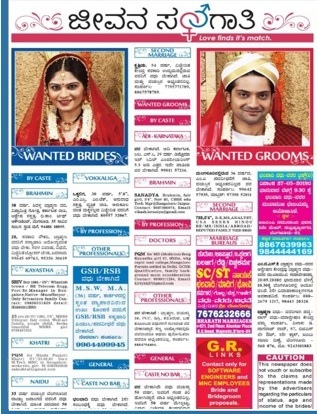
Ad in Punjabi Newspapers

Wedding Day ceremonies:

  • Gana Bandhna – On the wedding day, at their respective houses, the bride and the groom attend a puja in the morning. Once the puja is done, the priest ties a sacred thread or mouli to their right wrists. The thread is tied around a betel nut and a shell known as Kaudi. The thread is knotted multiple times around the wrists to make it hard to untie later.
  • Chooda Chadana – A set of red and ivory bangles generally in a set of multiples of four is known as Chooda. The eldest maternal uncle of the bride plays a vital role in this ceremony. He sits for a havan during which the chooda are purified in a mixture containing milk and rose petals. The head and face of the bride is covered during the ceremony as she is not supposed to see the chooda until the moment of her wedding. The maternal uncle and aunt slip the chooda into the bride’s hands. Other elderly members touch the chooda and give their blessings. The bride is also gifted her wedding Lehenga by her maternal uncle at this time. 
  • Haldi – During this ceremony, four diyas or lamps are lit and the bride sits on a low wooden stool facing them. A paste is prepared consisting of sandalwood, turmeric, rosewater and mustard oil and is applied all over the bride’s body especially face, hands and feet by the married ladies of the family. A similar ceremony is also observed at the groom’s house.
  • Ghara Gharoli – In this ritual, the bride visits a nearby temple and is bather with holy water. The same ritual is also done by the groom. 
  • Sarbala – A kid member of the family is chosen for this ritual where the member is dressed similar to the groom. He then accompanies the groom to the wedding.
  • Sehrabandi and Varna – The groom dresses up in his wedding attire. A small puja is performed in his honor. The turban and the Sehra is sanctified by the priest in this puja. The turban and the Sehraare tied around the groom’s head by an elder male member of the family.
  • Ghodi Charna – The groom is all decked up and sets off for the wedding venue by riding a horse. The horse is also decorated and tika is applied on his forehead. The horse is fed chana dal and water by the female relatives of the groom. The groom’s sister-in-law applies surma to the groom’s eyes and then the groom mounts the horse in a traditional manner. He is then accompanied by members of his family who sets off for the wedding venue along with him. The wedding procession is accompanied by a band that plays peppy music and the members of the wedding procession dance to it’s tune. 
  • Agwaani and Milni – After the groom arrives at the wedding venue along with the family, they are welcomed by the bride’s family. This ritual when the groom and his family arrive at the wedding venue is known as Agwaani. The groom is then welcomed by the mother of the bride with a traditional arti and tika on the forehead. They greet each other and are welcomed inside the venue. This ritual is known as Milni.
  • Varmala – The groom is led towards the stage and is made to stand upon a small pedestal. The bride arrives at the stage and the couple exchange garlands. This is a ceremony where there is competition among the two sides to lift either the bride or the groom higher so that the other cannot put the garland over his or her head.
  • Madhuperk – The bride and groom then proceed to the wedding mandap and the groom is offered a small bowl of water that he has to drink. He sprinkles some on his feet and drinks the rest. He is then offered a special concoction made with honey, curd, milk, ghee and other sacred essences. This is known as the Madhuperk. The groom is to take a sip off this drink before the wedding rituals commence.
  • Kanyadaan – During this ritual, the bride is given away by his parents to the groom. He requests the groom through mantras to take good care of his daughter and the groom accepts the bride’s hand and promises her father that he will treat her with love and respect throughout his life.

The wedding havan is lit. The fire deity is the foremost witness of a wedding. The groom is handed over a plate which has fourteen parallel lines drawn on a bed of flour with a flower. The lines symbolize fourteen vows of a marriage. The priest outlines these vows one by one through Vedic mantras; the groom repeats after him and erases one line with a flower bud.

  • Phere– Next, the couple gets up. The ends of their dupattas are tied in a knot and they encircle the sacred fire four times. For the first three times, the bride precedes the groom and for the final phera she has to follow the groom.
  • Lajahom – The bride’s brother pours puffed rice into her cupped hands. The bride and the groom then offer this to the fire together and seek the Fire God’s blessings. This ritual is repeated thrice.
  • Sindoor Daan – The groom applies sindoor to the bride’s hair parting and ties the Mangalsutra around her neck. This completes the wedding rituals.
  • Joota Chhupai – When the groom is busy with the wedding rituals, the bride’s sisters take hold of his shoes and hide them. The bride’s sisters demand a ransom for returning the shoes. There is a lot of bargaining involved between the two parties and they come to an agreement. The groom has to pay the agreed upon amount in order to get back his shoes and move from the mandap.

Post-wedding Rituals: 

  • Vidaai/Doli – The bride bids a tearful goodbye to her family and throws handful of rice over her shoulder in her family’s direction. This way she expresses her gratitude towards them for taking care of her for so long. She is then sent off in a decorated car to her husband’s home. This return bridal procession is known as Doli.
  • Paani Bharna – On arrival of the Doli, the groom’s mother does an arti of the bride with a pitcher of water. After each circle, the mother-in-law attempts to take a sip of water, but the bride prevents her from drinking. She finally relents after the seventh circle. She then crosses the threshold after overturning a pot of rice with her right feet.
  • Mooh Dikhai – The couple is then taken to seek the blessings of the family deity. The bride is seated and her veil is lifted for all of her family and friends to see. The elders of the family then shower their blessings on the bride and give her gifts of cash and jewelry.
  • Reception – A lavish reception party is thrown by the groom’s family in honor of the newlyweds. A Punjabi reception is an occasion of immense joy with delicious meals and high-spirited music.
  • Pag Phera– The bride returns to her parent’s home with her husband. The parents welcome their daughter and son-in-law with a grand lunch. The couple has to spend the night at her parent’s place. The next day she returns to her husband’s home with a lot of gifts for her in-laws. This marks the end of the wedding celebrations.

Initially, the whole of this ritual starting from finding a suitable match till the wedding, was done by the matchmakers and the arrangements were made by the relatives and the family members. But with the passing time, the matchmaking is mostly done by placing an ad in the newspapers or posting the profile on the online matrimonial portals. releaseMyAd, helps people to advertise in any newspaper of their choice in selection of the right match. Having more than 10 years of experience in the advertisement industry, releaseMyAd has served more than 3 lacs happy clients. You can book your matrimonial ads in more than 250 newspapers based on your choice of newspaper, Tribune, Ajit, Jagbani, Punjab Kesari being the most popular newspapers for Punjabi matrimonial advertisements. 
To book your Punjabi matrimonial advertisement in the newspaper, you can click on the link https://www.releasemyad.com/newspaper/cat/matrimonial/punjabi. You can also email us at book@releasemyad.com if you have any query related to your matrimonial ad. You can connect with us at 9830629298 via call or whatsapp or take the help of the Live Chat support which is available for 24 x 7.

Five Questions about Times of India Matrimonial that may come to your mind while placing an advertisement

All across India, if there is one newspaper which is trusted by parents for finding their son or daughter’s perfect match, it is Times of India. For generations Times Matrimonial classified section has served the need of finding the life partner of girls and boys eager to settle down and have a family. Today with over 3 million copies of the newspaper in circulation and a readership figure of over 7.6 million, Times matrimonial section is the best place to advertise across different states for finding a suitable bride and groom.

Wanted Bride & Groom Ads in Times of India

Every Sunday, hundreds of matrimonial ads are published in Times matrimonial section under various sub-categories of Brides and Grooms. Therefore, there are few basic things that should be kept in mind so that the readers are attracted towards your ad and favourable response is generated. While composing a matrimonial ad, there are certain questions that arise in the mind. If the advertiser goes ahead and addresses these, then there is all certainty that the attention of the readers is gained and the number of genuine response is high.

  • What are the things about the bride or groom that you should let the readers know?

There are few details about the bride and groom that must be included in a matrimonial ad. The first is age and educational qualification. The highest qualification should be included in the ad matter.  The family background should be added next and along with that detail of the profession. Food habits and physical characteristics can also be included for better response.

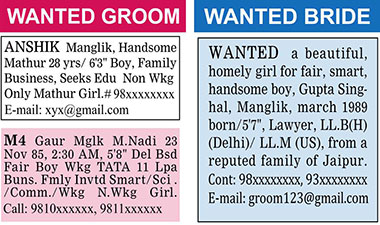
times Of India matrimonial Ad
  • Are astrological details of the bride or groom required in the ad text?

While it is not mandatory to add astrological and horoscope details if you do not have faith in the stars but if you actually care about the impact of stars and planets upon the future of the bride or groom, then you should add the same. It will also help you narrow down on those readers who share your belief and are eager for horoscope matching.

  • How important is placing a matrimonial ad under proper sub-category?

It is of utmost important to publish a matrimonial ad under a proper sub-category. Times of India Matrimonial section offers the option of selecting sub-categories based on caste or religion. If you wish to advertise otherwise there is the option of placing the matrimonial ad under sub-categories like By language, By profession, By community, Cosmopolitan, Caste No Bar, Religion No Bar, etc. Choose the most appropriate sub-category so that the readers can filter down to your ad based on what type of bride or groom they are looking for.

  • Is it also required to mention what type of bride or groom I am looking for?

The kind of bride or groom you are looking for should be mandatorily included in the ad text. You can mention whether you are looking for a bride with a particular qualification or a groom serving a certain profession and so on. This will help you receive genuine responses rather than unwanted enquiries.

  • Which is the best matrimonial package I should go with?

There are multiple matrimonial packages available in Times of India and sometimes it can be a bit confusing which one should be chosen. Focus on the package which has the location from where you want the prospective bride or groom. You can opt for a package which has the edition that covers that location. Then you can broadly decide on other nearby locations and chose the package that has those editions which cover nearby locations. If you are open with getting a bride or a groom from anywhere in India, you can go ahead with All Editions package.

To assist you with proper ad text composing and selecting the correct tailor-made package suitable for your need, releaseMyAd is here to help you. Through releaseMyAd you can book Times of India matrimonial ad online without any hassle. Having decades of experience in the advertising industry and being the online partner of Times of India ad booking, releaseMyAd is known for its reliability and trustworthiness. Click on the link https://timesofindia.releasemyad.com/rates/matrimonial and you can yourself go ahead with booking a matrimonial ad in Times of India through our self-support platform. You can also reach out for any assistance to the experienced customer support team over Phone/ WhatsApp number 9830629298. For detailed enquiry, you may drop an email to book@releasemyad.com or you may also connect 24*7 Live Chat support on releasemyad website for instant reply.

10 secrets you would like to know about Times of India Classified

Times of India is one of the best-known newspapers in India and it has been reporting daily news since the last 180 years. People have built trust around this newspaper and therefore it reaches out to many millions throughout the country. Times of India classifieds which is known as Times Interact is one of the powerful platforms for any individual or businesses to get hold of this immense readership base of Times of India to fulfil their advertising and promotional needs.

However, reaching out to the mass audience doesn’t actually mean achieving advertising goals. Proper targeting and getting in touch with the right audience will ensure the same. Let’s check out a few secrets which will make sure that the advertisement is done in the correct sense.

1.       That because you have a huge Times Interact page, there is all possibility that your ad might get lost among other ads. Special Enhancements options provided by Times of India are best for amplifying your ad among the clutter. Colour enhancement, Tick, screen and run-on-display are the few enhancements that can make a classified ad in Times Interact page impactful.

2.       Choosing the correct release date matters the most. Whereas all categories of ads publish all days of the week, except Matrimonial which publishes only on Sundays, there are few categories which have a special focus day. Best day to publish a recruitment ad is Wednesday and for Education, it’s Monday. Property ads publish in the Times Property section of Times Interact on Saturdays. An ad published on a focussed day generates extra responses.

3.       Always opt for the correct category and sub-category. No reader goes through the entire Times Classified page. They only check out the column which they require. Therefore, it is most essential to select the appropriate category and sub-category to receive relevant responses.

4.       Ensure to verify the newspaper edition which reaches the location where you want to focus your advertisement otherwise the entire campaign will be in vain. There are various small city locations which are covered by larger editions. An advertisement published in the wrong edition will generate no response whatsoever.

5.       Classified ad booking packages of Times of India are tailor-made for advertisers who want to advertise in multiple locations. These packages are pocket-friendly options and booking in one of these packages rather than a single edition ensures reaching out to a wider audience.

Times of India Classifieds

6. Many of the packages also include sister publications of Times of India like Maharashtra Times, Vijay Karnataka, Ei Samay, etc. Carefully choosing such a package will allow an advertiser to reach out to the audience speaking the local language of the state.

7.       Go ahead with multiple insertions offers if you are thinking of publishing your ad for more than one day. Offers like 2+2 and 3+3 are available to publish classified advertisements in Times of India. These offers not only saves money but multiple day ad releases multiply the responses of the ad.

8.       The ad text you are publishing should be crisp and short. The message that you wish to deliver needs to be summed up with basic points. A large ad matter for classified ads not only costs extra but also disinterests the readers.  Never forget to add the contact details in the ad text. It is better to add email id and a contact number.

9.     Ensure to mention the USP in the advertisement so that the readers are attracted to the special something in your product, service, property to be sold or rented or for instance special qualities of the prospective bride or groom in case of a matrimonial ad. For recruitment advertisements, the USP can be the special facilities of the job in the offer and it can be the amenities and advantages of the institute in case of an Education ad.

10. Times Interact page not only publishes Classified Text ads but also Classified Display ads which are in a box of minimum 3 cm width and 5 cm height. Whereas the height can be increased as per the ad text, the width remains constant as per the column width of the newspaper. If you are opting for such an advertisement make sure to use colourful fonts and background. An image or your brand’s logo gives added advantage. Dull coloured Classified Display ads can lose its purpose and there are all chances that the readers might overlook it.

We, at releaseMyAd have developed such an online platform where all the above details are available and the customers can easily navigate themselves through the website and select the options which will benefit their advertisement campaign. This self-serve platform has served more than 3 lakhs customers since its inception a decade ago. We are an authorized classified ad booking partner of Times of India.

For more details about the classified advertising in Times of India, visit https://timesofindia.releasemyad.com/classified/Times-of-India-Newspaper-Ad You can reach out to the expert team of customer support with your questions and queries at phone/ WhatsApp number 9830629298 or drop an email with your requirement to book@releasemyad.com. For urgent support 24*7 Live Chat option is also available on the website.

How can you place a Public Notice ad in Dainik Bhaskar Newspaper!

If we go back to history  it can be seen that the concept of notice is older than the existence of newspapers. Earlier, the cases were notified on public squares regarding any important legal proceedings, in order to make the public aware and to give notices to interested parties, in specific.  Later, with the advent of the newspapers, the orders coming from the King’s Court were published and circulated amongst the public. But with evolution the common method now is the print in newspapers.

Public notice are a an important part of the legal process to notify citizens about any ongoing or completed legal proceedings and is often considered to be of high value.  This is commonly done by  placing advertisements in newspapers and  is used as a medium to make people aware of any legal proceedings that have already taken place or are going to take place in the future.

Public notice is actually a formal announcement which is published in a newspaper legally by common individuals, companies or government as well.

Importance to publish public notice in Dainik bhaskar:

  • Notices are important to create public awareness of government activities, court hearings, public bids therefore to reach maximum people Dainik Bhaskar is a very good option as it covers the entire central northern parts of india.
  • Placing Dainik Bhaskar public notice ads is a most effective method of reaching a wide group of public because of its high circulation figure and is a pocket friendly option.
  • By printing public notices ads in dainik bhaskar newspapers end up serving both the public and the government. Public notices have a great responsibility as they inform the public of actions either big or small..
  • It accepts any public notice ad in the minimum size of 4cm X 4cm and the booking deadline is just one day prior. 

Documents required: There are various types of public notices ads and the documents depend upon what type of public notice you want to publish.

  1. Share Certificate Loss Notice: If the original share certificate gets lost, these ads are published to inform the general public & to file an application for issuing a duplicate share certificate.
    • Documents Required: Copy of FIR or General Diary Entry. Should not be more than 6 months old.
  2. Property Notice:  While making a property deal or to inform about a disputed property or change of ownership of a property these notices are published which make the process more transparent.
    • Documents Required: Ad matter in Advocates letterhead duly stamped and signed.
  3. Notice for claim against legal heirs or nomination of the property: This notice is given to ensure that everyone gets his or her part or to claim for this partition after the owner passes or is not divided by the owner.
    • Documents Required: Ad matter in Advocates letterhead duly stamped and signed.
  4. Court Notice: This notice is published to Inform the general public about the legal action taken about the legal proceedings or summons sent from the court, who is unreachable.
    •  Documents Required:  Ad matter in Advocates letterhead duly stamped and signed, court’s judgement copy or court summon.
  5. Company Notice: Notice published to inform the public about annual general meetings, change in management, change in registered name or address of company, employee absconding notice, etc.
    • Documents Required: Ad matter in company’s letterhead duly stamped and signed by the authorized signatory.
  6. Marriage Notice: To notify marriage of Indian nationals with foreigners in a foreign land.
    • Documents Required: Authorization letter from the Indian High Commission or Embassy in foreign land duly stamped and signed.
  7. Disownment Notice: Notice to the general public that a family members have been disowned from property and other family authorisations.
    • Documents Required: Ad matter in Advocates letterhead duly stamped and signedNotarized Affidavit of disownment.
  8. Bank or Auction Notice: To notify customers about some amendments in rules, to inform auctions against mortgage property, etc.
    • Documents Required:  Ad matter in Bank’s letterhead duly stamped and signed by authorized signatory.

With a few clicks you can book a public notice ad by just following this link & the steps given below:  https://dainikbhaskar.releasemyad.com/rates/public-notice

  • Select the Edition i.e the place you want to publish your ad.
  • Choose the design templates you like and edit it with your ad matter OR you can upload pre-designed ad creative from your computer.
  • In case you want us to design your ad content you can’t contact on the below given details.
  • Click on Select Date and Make Payment and proceed to choose your preferred date from the calendar.
  • Preview your booking details and upload the supporting documents.
  • Go ahead and make the payment through your preferred mode.

All the details of payment, ad status, invoice everything will be mailed to you on your registered email id. You can check and keep a track there about what’s happening with your ad in its editorial approval – to – processing to – release confirmation on your email itself.

Trust Lokmat with your Matrimonial Advertisements!

Arranged marriages still remain the majorly preferred, as per servey even now around 85 percent of people prefer to marry the boy or girl chosen by their families, rather than choosing their life partners themselves. Arranged marriages are viewed not as something done based on feelings, but something done based on a commitment and through that commitment, feelings will develop with time.

Historically speaking, weddings during the Vedic times took place by a variety of methods. While arranged marriages were preferred, the consent of the bride was generally taken into consideration. In case of royal families, parents arranged a Swayamvar, a ceremony where suitable matches from all over the country were invited. Thereafter, either these suitors had to prove their prowess to win over the girl, or the girl herself will choose one of them, by offering him a flower garland.

Nowadays The planning of arrange marriage starts with putting up a Matrimonial ad. People give matrimonial ads to find out the best partner for them. People put these ads with an expectation of getting proper quality responses Therefore choosing your newspaper wisely is a must. Isn’t it ? 

The major reasons for you to think about advertising a matrimonial ad in Lokmat are: 

  • Huge Readership: Lokmat is no.1 and Largest read marathi daily with 2.18 cr readers which is famous and popular among all groups of people in the entire Maharashtra.
  • Location coverage: Lokmat has 11 Marathi editions covering entire Maharashtra and Goa. Lokmat is published from Mumbai, Pune, Nagpur, Aurangabad, Nashik, Kolhapur, Jalgaon, Ahmednagar, Solapur, Akola & Panaji. They have also added a new edition name Delhi.
  • Cost of Advertising is Low: The cost of advertising is quite low if we compare with the other available options, the coverage and popularity. Its rates are designed to serve all groups of people and offer a very pocket friendly convenient way of getting responses by spending less amount.
Lokmat Matrimonial Ad
  • As discussed earlier it has 11 editions the rates of placing a matrimonial ad is in between Rs. 60 – Rs. 1150 per 7 lines varies according to the edition selected by you.
  • Another attractive part is it has an all edition package of Rs. 7170 for 7 lines which will cover every corner of Maharashtra.
  • It has few attractive  and selective enhancements available to highlight your ad in the classified page like font color, bold box, bold box color etc.  which you can avail by paying the additional premium charges.
  • Special Offers: Offers various insertion offers like Book 3 Get 1 Free, Book 5 Get 2 Free, Book 8 Get 4 Free , Book 12 Get 8 Free to gain your interest.
  • Available as epaper: Your ads will be reflected in physical copy of the paper plus in the online epaper which can be accessed for free. 

Sub sections of matrimonial ads

Matrimonial ads are only divided into two sub columns in lokmat they are:

  • Wanted Bride: Where the family of the prospective groom advertises under Wanted Bride section where they mention what type of bride they prefer.
  • Wanted Groom: The family of the prospective brides usually advertises under Wanted Grooms section where they mention what type of groom they prefer.

How to compose your ad content tips:

The effectiveness of the ad always depends on the composition of the ad. Thus, here are few tips which will help you to create ad content which will fetch a  good amount of quality responses.

  • Please check the contact details in the ad text to get a response. Also provide, if any, preferred timing for communication.
  • Ensure to mention DOB, time, place of birth, Manglik/ Non-Manglik and other astrological details for kundli/ zodiac matching.
  • Mention age and height so that responses are received from relevant age bracket and physical specifications.
  • Share any special preference, if any, like divorcee, non-divorcee, separated, NRI, physical disabilities, medical conditions.
  • Mention Religion, Caste, Community or No Caste Bar to ensure the right response from required social background.
  • Mention Educational/ Professional qualification looking for, to get a suitable qualified match.
  • Enumerate the profession, occupation, salary and place of residence to get appropriate response from desired lifestyle background.

 Ad formats & samples for Lokmat Matrimonial ads

Sample 1: Wanted Bride for our son

We are looking for an alliance for our son (Name), aged (30) years, residing in (Location), height (6’1″), (B.Com) graduate, (Religion), (Caste). The bride should hail from a decent, educated family. (Same caste/ caste no bar). Should be around (24) years. Contact with (Astrological) details 0000000000 or Email to mail@mail.com

Sample 2: Wanted Groom for our daughter

PQM for (Location) based fair girl, 1980 / 163 cm, Corporate Lawyer, LLM/UK, parents Sr. Exec., seeks liberal minded, suitable match in early 30’s. E: mail@mail.com with photo. Caste no bar.

Sample 3: Divorcee / Remarriage

(Location) based (Religion) issueless divorcee boy 30/6’1” BE wrkg with MNC seeks suitable (Veg./Non Veg.) match. Contact : 0000000000 E: mail@mail.com

Sample 4: Bride Wanted for NRI 

क्षत्रिय मराठा 42/ 5’3″ NRI लंडनमध्ये स्थायिक नोकरीतल्या मुलीसाठी लंडनमध्येच स्थायिक हिन्दू मराठी क्षत्रिय किंवा ब्राह्मण वर पाहिजे व्हॉट्सएप फक्त 0000000000

Sample 5: Buddhist Groom Wanted

 बौद्ध- वधु-25, MBBS सरकारी अधिकारी मुंबई। अनुरुप बौद्ध स्थळ पाहिजे। व्हाट्सअप्प मोबाईल न 00000000000

Deadline of placing Lokmat  matrimonial:

If you are thinking to place a matrimonial ad for the coming week let me tell you the focus day for these ads are Sunday and It’s Easy to post ads for the next day as the deadline is flexible till 3 noon which means ultimate deadline for posting the ad for Sunday is within Saturday 3 noon.

releaseMyAd wants and tries to fulfil their client wishes till the end and we are here to help you to place your ad whenever and wherever you just plan. Through releaseMyAd, you could easily book Lokmat matrimonial ads online in a few simple steps. You can simply click into the given below and start exploring us to place your ad: https://lokmat.releasemyad.com/rates/matrimonial

  • Select the ad type – Classified Text or Classified Display
  • Choose the discount Package with your preferable location where you want to release the advertisement.
  • Next choose appropriate ad heading (wanted brides/grooms)
  • Proceed to compose the classified text ad you can check the “View sample ads” section for help. You can upload self-designed matter or edit the given templates in case of classified display ads.
  • Lastly, choose the publishing date for the ad and make the payment. You can clear the payment using Credit/Debit Card.

All the details of payment, ad status, invoice everything will be mailed to you on your registered email id. You can check and keep a track there about what’s happening with your ad in its editorial approval – to – processing to – release confirmation on your email itself.

Contact Details:

If you are still confused about how to book Lokmat matrimonial ads, do not worry we have our experts who can help you with each and every step of booking from placing your ad to composing to publishing. You can reach our team on 9830629298 or mail us at book@releasemyad.com. You can also contact us via the online chat option from our website.
By allowing us to serve, you will save your time and money and will be getting the best available option for your advertisement on your area according to your pocket and need.